Wedding Timeline for Photos: A Realistic UK Schedule
A good wedding photo timeline gives each part of the day the time it needs, and puts the portraits where the light is kind. For most UK weddings that means roughly 3 to 4 hours of getting ready, 20 to 30 minutes for group photos and 20 to 40 minutes for the two of you, according to Weddings Hub’s UK guide. Below you’ll find those building blocks, a sample day you can copy, and the decisions that change the shape of it.
We work with queer couples and families across London, and the same thing happens again and again. The couples who enjoy their photos most aren’t the ones with the longest list. They’re the ones who left enough breathing room that nobody was hurried.
TL;DR
- Plan the photo timeline before the rest of the day, because the light decides what works. Weddings Hub recommends this order.
- Budget about 20 to 30 minutes for group shots and 20 to 40 minutes for couple portraits, plus a buffer for each.
- Most UK couples need 8 to 10 hours of coverage for a single-venue day. Fewer if you are marrying at a register office with a small party.
- A first look moves your portraits away from the busiest part of the day. It’s a choice, not a rule.
- Keep your group-photo list short and give someone a job as the “finder” of relatives.
Table of Contents
- Start with the light, not the venue
- How many hours of coverage do you need?
- Stage by stage: how long each part really takes
- A sample timeline for a 2pm ceremony
- First look: pros and cons
- Build your day around what matters to you
- Timeline tips for London weddings
- Find a photographer who plans it with you
- FAQ
- Sources
Start with the light, not the venue
The most common mistake is building the day around the venue’s logistics: when the room is free, when the caterer wants to serve. Then the photographer is handed whatever time is left. That’s how couple portraits end up at 1pm under a hard sun, or at 5pm in a dark October garden.
Flip it. Work out when you want the best light, put your portraits there, and let the rest of the day arrange itself around them. Weddings Hub’s advice is to build the photography timeline before the overall wedding timeline, because the light dictates the schedule.
In the UK this matters more than most couples expect, because daylight changes fast across the year. In London, sunset on 1 October 2026 was at 18:37, according to published sunrise and sunset tables, and it moves earlier every day after that. A winter wedding has far less usable daylight again. Check the sunset time for your exact date and work backwards. If you want portraits in warm, low light, aim to start them about an hour before sunset.
If you’re marrying indoors in winter, don’t panic. A good photographer will use window light, lamps and flash, and you can plan portraits straight after the ceremony while it’s still bright outside.
How many hours of coverage do you need?
There’s no single answer, but the shape of your day gives you one quickly.
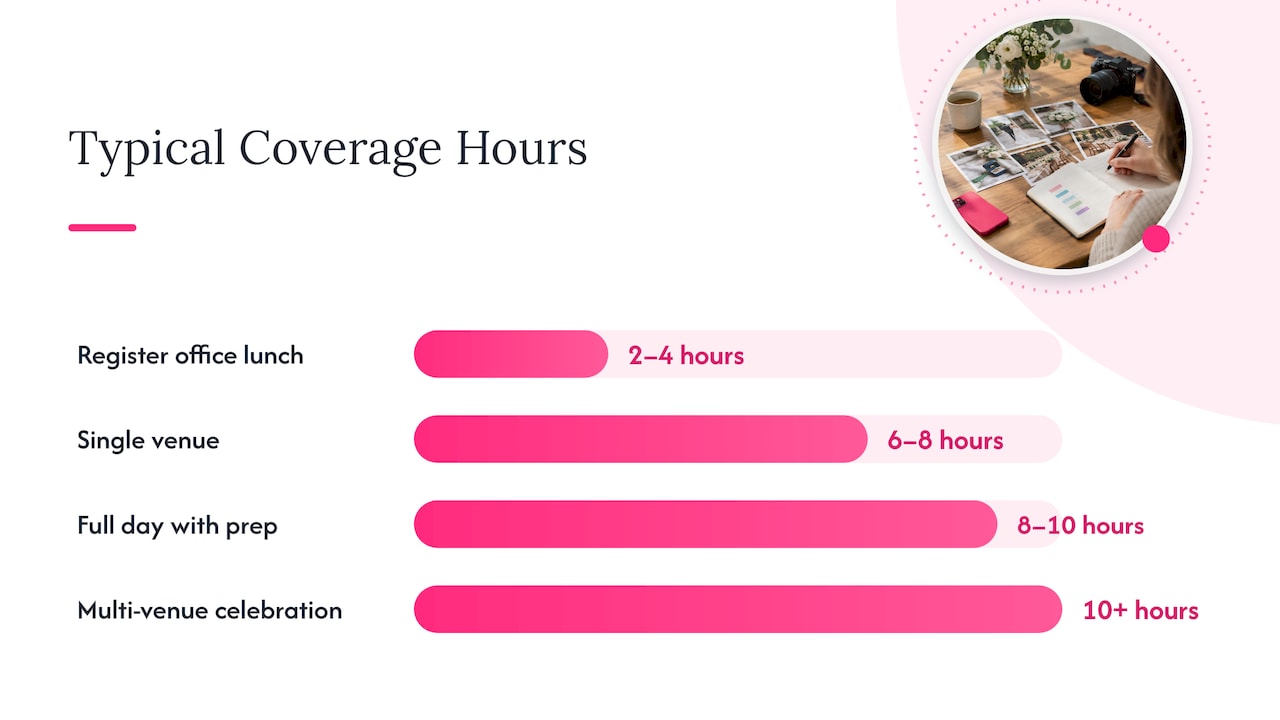
| Type of day | Typical coverage | What it usually includes |
|---|---|---|
| Register office and small lunch | 2 to 4 hours | Arrival, ceremony, portraits, the first part of the meal |
| Single venue, 40 to 80 guests | 6 to 8 hours | Ceremony, groups, portraits, speeches, first dance |
| Full day with prep | 8 to 10 hours | Getting ready, ceremony, drinks, meal, evening party start |
| Multi-venue or two-part celebration | 10 hours or more | All of the above, plus travel between locations |
These ranges are our working guidance, not a rule, and your photographer will refine them once they know your plan. A useful way to think about it: count the moments you would be sad to have no photo of, then see which hours they fall in. Coverage should stretch from the first of them to the last.
Two things quietly eat time. Travel between places (a ceremony in one borough and a reception in another is common in London) and late starts. Add 15 minutes to any ceremony start time in your head, and build it into the plan as a buffer rather than hoping for punctuality.
If you’re weighing coverage against how many images you’ll receive, our guide to how many wedding photos to expect explains the numbers to put in a contract.
Stage by stage: how long each part really takes
Getting ready: 3 to 4 hours of morning, 1 to 2 of photography
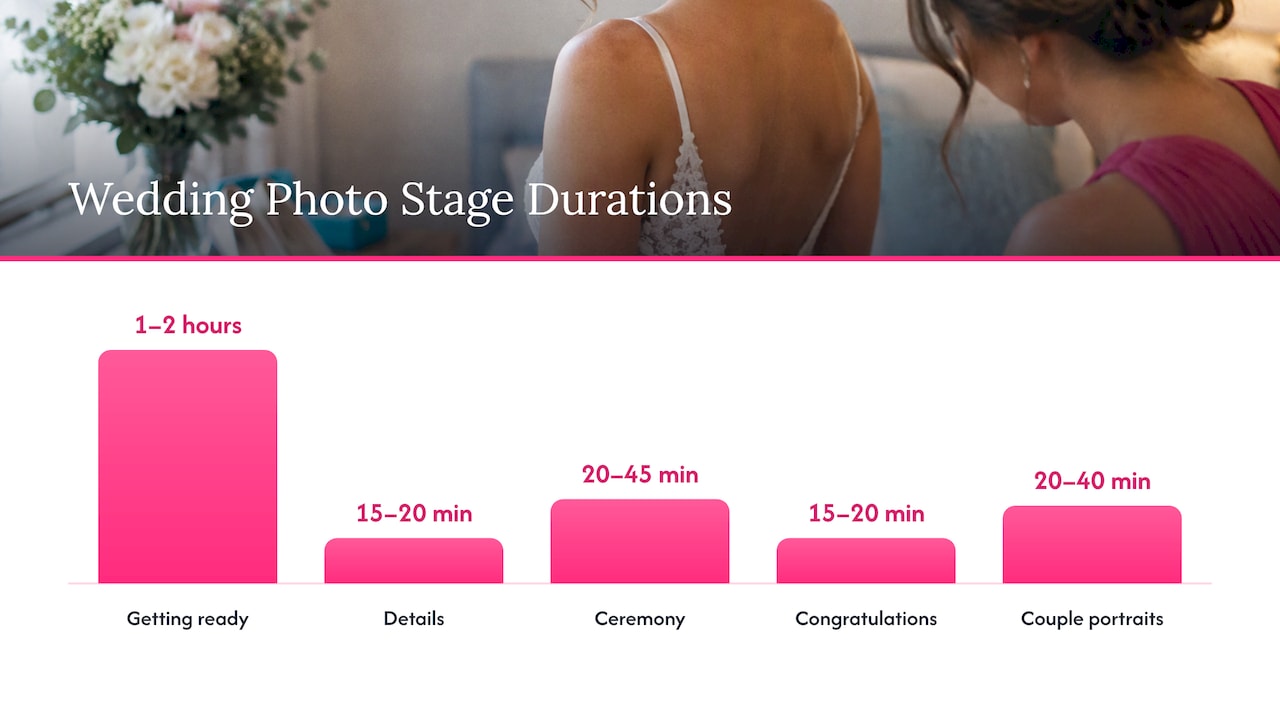
Weddings Hub suggests allowing 3 to 4 hours for getting ready. That is the whole morning, including hair, make-up, breakfast and dressing. Your photographer doesn’t need to be there for all of it. Most couples want them for the last hour or two: final touches, the outfit going on, a quiet word with a parent or best friend, the flat as you arranged it.
If you’re getting ready together, which many of our couples do, tell your photographer. It changes where they stand, and it can make the morning feel a lot calmer.
Details: 15 to 20 minutes
Rings, shoes, flowers, stationery, the suit or dress hanging in a window. Ask someone to gather these into one tidy spot before the photographer arrives. It saves a surprising amount of time and means the details get photographed in good light, not rushed at the end.
Ceremony: 20 to 45 minutes, plus arrival
A civil ceremony is often short, around 20 to 30 minutes. Religious or multi-part ceremonies run longer. Ask your venue or celebrant how long they allow and whether flash or movement is restricted, because some register offices and places of worship have rules about where a photographer can stand. Tell your photographer in advance, so there are no surprises on the day.
Confetti and congratulations: 15 to 20 minutes
This is the part everyone forgets to schedule. Guests want to hug you, and you want to let them. Plan a short, unstructured window straight after the ceremony. The photographs from it are often the warmest of the day.
Group photographs: 20 to 30 minutes
Weddings Hub puts group shots at 20 to 30 minutes. Each group takes about two to three minutes once people are gathered, so ten groups is a realistic ceiling for that slot. Keep the list short and written down. Here’s what makes it go smoothly:
- Give the list to your photographer a week or two before the day.
- Choose two people who know both sides of the family to round up relatives.
- Order the groups from largest to smallest, so people can drift away to the drinks.
- Think about the groups that matter to you. Chosen family often belongs on the list as much as blood relatives, and you should say so plainly.
Our printable wedding shot list is built for exactly this, including families that don’t fit a template.
Couple portraits: 20 to 40 minutes
The same guide suggests 20 to 40 minutes for couple portraits. Don’t let that number scare you into thinking you need an hour away from your guests. Most people find that after ten awkward minutes they stop performing and start enjoying it. If you’d prefer a shorter slot, split it: ten minutes after the ceremony, ten at golden hour.
If you’d like portrait ideas to bring with you, here are 12 LGBTQ+ wedding photo ideas to share with your photographer.
Drinks, meal and speeches
A photographer doesn’t need to shoot the entire meal. Ask for the room before guests sit, the speeches, the cake, and perhaps a few candid tables. If you have a tight budget, this is a sensible place to stop coverage or take a break so your photographer can eat too.
Evening: first dance and a little beyond
The first dance and the first half hour of the party give you the best energy for the least time. After that, most couples are happy to let the dance floor go unrecorded. If the party matters to you, extend coverage and say so.
A sample timeline for a 2pm ceremony
Use this as a starting point and change it to match your day. It assumes a single venue and a spring or summer date. For an autumn or winter wedding, shift everything earlier.
| Time | What happens |
|---|---|
| 10:30 | Photographer arrives as hair and make-up finish |
| 11:00 | Details and final preparations |
| 11:45 | Getting dressed, a private moment with someone close |
| 13:15 | Guests arriving, photographer moves to the venue |
| 14:00 | Ceremony |
| 14:30 | Confetti and congratulations |
| 14:50 | Group photographs |
| 15:20 | Drinks begin, couple portraits (20 to 30 minutes) |
| 16:00 | Back with guests |
| 17:00 | Room shots, then the meal |
| 18:00 | Speeches |
| 19:30 | Cake and first dance |
| 20:00 | Photographer finishes (about 9.5 hours) |
Notice the gap between 16:00 and 17:00. That’s deliberate. It’s your buffer. If the ceremony starts late or the groups overrun, the day absorbs it without anyone being rushed.
If your venue slots are tight and you want to keep the flow without hurrying, a printed one-page schedule for the best person and the venue coordinator helps. A design and branding studio that also offers custom photography can be a handy reference if you want to see how a visual plan is laid out clearly.
First look: pros and cons
A first look is a private moment before the ceremony when you see each other for the first time. Many couples consider it only for photographs, but it’s more about how you want to feel.
Pros
- Portraits happen before the ceremony, so you can join your guests at drinks.
- You get a quiet, unobserved moment before everything speeds up.
- It protects your photo time if the light fades early, which is a real consideration for an autumn or winter date.
- Nerves often settle before the ceremony.
Cons
- You lose the moment of seeing each other at the end of an aisle, if that matters to you.
- You need to be dressed and ready earlier, which pushes the morning along.
- Some families and faith traditions prefer not to.
Neither choice is better. We find that couples who don’t follow the traditional pattern, such as two brides, two grooms, or partners who are walking in together, often choose a first look simply because there isn’t a fixed script for them. Do what feels like yours.
If you’re deciding how you want the day documented overall, our guide to documentary versus traditional wedding photography can help you decide how much posing you want, which in turn affects how much time you set aside.
Build your day around what matters to you
A timeline is not a test. It’s a way to protect the moments you care about. Before you finalise it, ask yourselves:
- Which three moments would I most regret not having photographed?
- Who must be in a group photo, and who is there as a guest?
- Do I want a quiet hour at any point? Where in the day does it fit?
- Is there anywhere I’d rather not be photographed, or anyone I’d rather not be pictured with?
- Are my pronouns, names and family arrangements clear to the photographer?
That last question matters more than it sounds. A photographer who knows your names and your family set-up in advance will never be caught guessing at the altar. If you want one who keeps you with your guests and doesn’t pull you away for hours, read how to choose a wedding photographer who keeps you at the party.
Timeline tips for London weddings
London adds its own wrinkles. Travel across the city on a Saturday can take far longer than the map suggests, so allow at least 30 minutes between venues, and more if you’re crossing the river. Register offices often run to a strict timetable with back-to-back ceremonies, so ask how much time you get for photos in the building and whether there are limits on where you can stand outside. Many parks and public spaces need permission for professional shoots, so check before you promise a location.
If your day has a blended guest list, with friends from the scene, family from elsewhere and colleagues, it helps to tell your photographer who knows whom. Our page for a queer wedding photographer in London with blended guest lists goes into how we think about this.
And don’t forget the time after the wedding. Once the day is over, you will want to know when your photos arrive. We’ve written about what to expect on wedding photo turnaround and your contract.
Find a photographer who plans it with you
At Queer.Photo, we match you with a vetted queer photographer, personally, by a real person rather than an algorithm, often within 24 hours. Every photographer is represented by us, every image is original (never stock or AI generated), and every shoot respects your pronouns and boundaries. We can talk through your timeline with you before you book. Take a look at our packages and options, or if you know the kind of day you’re having, start with our queer wedding photographer service in London. You might also be looking for a same-sex wedding photographer in London or a trans and non-binary wedding photographer, and we have pages for both.
FAQ
How many hours of wedding photography do I need?
For a single-venue wedding with a ceremony, drinks, meal and first dance, most couples book 8 to 10 hours. Smaller register office weddings often manage with 2 to 4 hours. Count the moments you want photographed, and book from the first to the last.
How long do family photos take at a wedding?
Plan on 20 to 30 minutes in total, according to Weddings Hub. Each group takes two to three minutes, so keep the list to around ten. A written list and two relatives who can round people up make the biggest difference.
In what order should wedding photos be taken?
A common order is getting ready, details, ceremony, confetti, groups, then couple portraits, with portraits moved to golden hour if the light suits. With a first look, portraits happen before the ceremony and the groups follow straight after it.
Should we do a first look?
It depends on what you want to feel. A first look gives you a calm, private moment and frees up time after the ceremony. If you want to see each other at the end of the aisle, you can skip it and still get lovely portraits.