How Many Wedding Photos? Use 100–150 per Hour to Set Your UK Contract
Most full-day weddings come back with 800 to 1,500 edited images, with the industry rule of thumb landing around 100 to 150 final edited photos per hour of coverage. That range moves depending on how many hours you book, how your photographer edits, and how much happens on the day itself. It is a starting point for the conversation with your photographer, not a fixed promise.
TL;DR:
- For a three hour elopement, expect roughly 300 to 450 images; longer events across multiple venues with a second photographer can reach 1,200 to 1,800.
- Before signing, put coverage hours, an image count, editing details, file resolution, delivery method, turnaround, archive period, and usage rights in writing.
- Ask for a complete wedding gallery, not a highlight reel, because culling style determines whether a photographer delivers a tight selection or near duplicates.
- Share guest count, venue changes, traditions, and priority moments in advance; travel between locations uses coverage time without adding photographs.
- Edited files do not transfer copyright automatically; confirm your personal use license, any commercial permissions, and whether guest images may appear in promotion.
Table of Contents
- 1. Typical image counts by coverage length
- 2. What changes the final number of edited photos
- 3. What to put in the contract to protect your photo count
- 4. Turnaround, delivery and who owns your photos
- 5. How Queer.Photo helps you set a realistic photo expectation
- 6. How to tell your photographer what actually matters to you
- 7. Why more photos is not always the better outcome
- 8. Matching your photo count to your wedding size and style
- 9. What different packages tend to deliver
- Ready to book a photographer who sets clear expectations
- FAQ
- Sources
1. Typical image counts by coverage length
The easiest way to predict your gallery size is to multiply your booked hours by that hourly rule of thumb. It will not give you an exact number, but it gets you close enough to spot a package that is wildly out of step with what you are paying for.
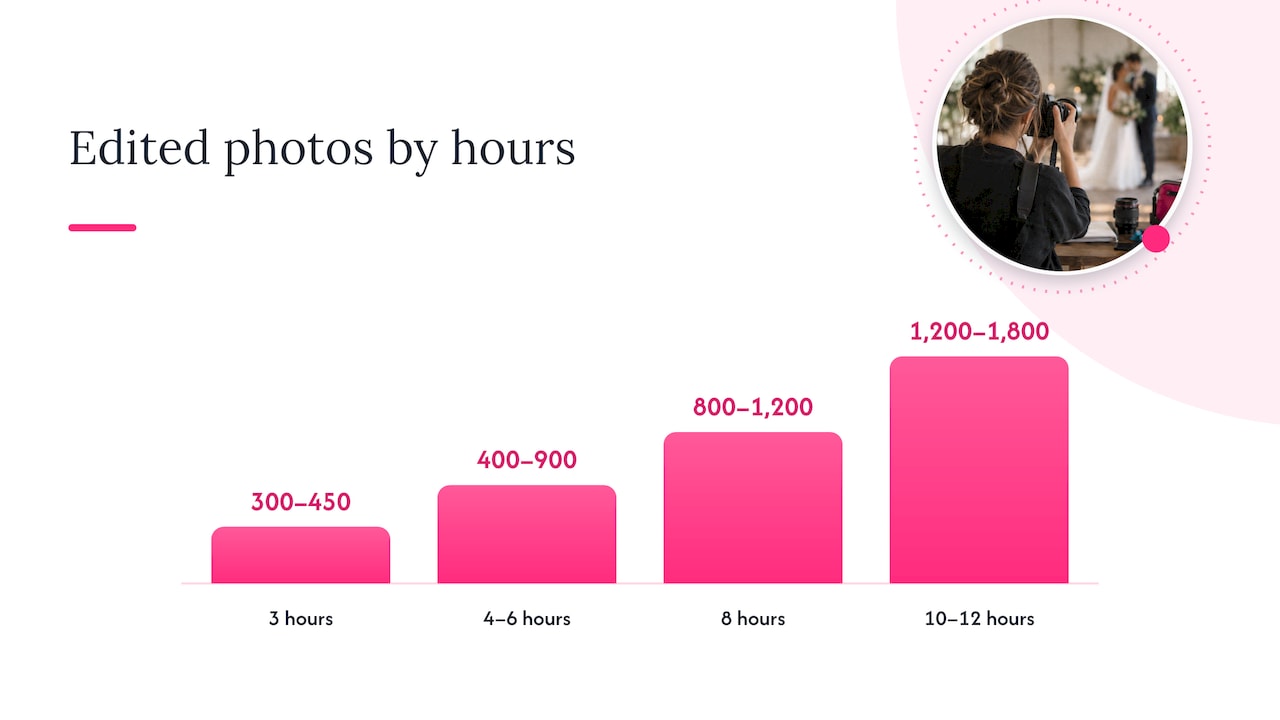
For a short, intimate ceremony of 4 to 6 hours, such as an elopement or a small registry office wedding, expect somewhere in the region of 400 to 900 final images, following the same 100 to 150 per hour guide. A standard full-day wedding of around 8 hours, covering preparations, ceremony, group photos and the first part of the reception, tends to land in the 800 to 1,200 range, occasionally stretching to 1,500 when a second photographer is on hand. Large, multi-venue celebrations running 10 hours or more, with speeches, dancing and an evening party, can push well past 1,500, simply because there are more hours and more distinct moments to document.
A few quick scenarios to help you self-classify:
- A 3 hour elopement with one photographer: roughly 300 to 450 images, enough for a complete, unhurried story of a small day.
- A classic 8 hour wedding with ceremony, speeches and first dance: roughly 800 to 1,200 images, covering the full arc from getting ready to the dance floor.
- A 10 to 12 hour celebration across two venues with a second shooter: often 1,200 to 1,800 images, reflecting the extra coverage and extra set of eyes.
None of this is a professional standard carved in stone. It is a useful sense check, nothing more.
2. What changes the final number of edited photos
Two photographers covering the same wedding for the same number of hours can hand back very different gallery sizes, and style is usually the reason. Some photographers curate heavily, culling duplicates and near-misses to leave only their strongest frames. Others deliver a more comprehensive edit that favours completeness over tight editing. Neither approach is wrong, but it changes what “edited photos” actually means in your contract.
A second photographer adds more vantage points and therefore more usable images, particularly useful for getting ready shots on both sides of the family or candid reactions during the ceremony. Event complexity plays a similar role: multiple venues, a long guest list, an extensive formal photo list, speeches and an active dance floor all add hours of material to sort through. Weather and light matter too. A wet, dim afternoon can mean a photographer rejects more frames for technical reasons, which trims the final count even when coverage time stays the same.
Before booking, look closely at a photographer’s full sample galleries rather than their highlight reel. A printable shot list can also help you and your photographer agree in advance on how many formal group portraits you actually want, which has a direct effect on the final tally.
Pro Tip: Ask to see one complete, unedited-to-edited wedding gallery rather than a curated portfolio. It tells you far more about volume and style than any highlight reel.
3. What to put in the contract to protect your photo count
A clear written agreement is the single best way to avoid a mismatch between what you expected and what arrives. Choosing a wedding photographer advocates putting the following in writing before you sign anything:
- Coverage hours, stated precisely, including start and end times.
- A minimum or approximate edited-image count, not just a vague promise of “full coverage”.
- A clear definition of “edited”, covering colour correction, cropping and any retouching included as standard.
- File types and resolution, so you know whether you are getting print-ready files or web-sized copies.
- Delivery method, whether that is an online gallery, a USB drive, or both.
- Turnaround time, given as a realistic window rather than a single date.
- Archive period, confirming how long your photographer keeps your files if you need a reprint later.
- Usage and copyright terms, spelling out what you are allowed to do with the images.
Phrasing matters here. “A minimum of 800 edited images” is far safer than “complete representation of the day”, which means very little if a dispute arises. Our contract clauses guide for securing wedding photo rights walks through the specific wording worth requesting. Under the Consumer Rights Act 2015, digital content supplied for a price must match its contract description, which gives you real standing if what arrives falls short of what was promised in writing.
4. Turnaround, delivery and who owns your photos
Once your wedding is over, the next question is when your gallery arrives and what you can do with it. Turnaround windows vary by photographer and season, so always confirm the expected timeframe in writing rather than assuming.
- Receiving your edited files does not automatically transfer copyright. Unless your contract says otherwise, your photographer generally remains the copyright holder, and you are granted a personal use licence to print, share and enjoy the images.
- If you want to use your photos commercially, such as in a business or publication, that usually requires separate permission beyond the standard personal licence.
- Photographs of guests count as personal data, so if your photographer plans to use guest images for portfolio or promotional purposes, it is worth asking about consent in advance.
Our own page on wedding photo turnaround time sets out a realistic 4 to 12 week window and the questions worth asking before you book.
5. How Queer.Photo helps you set a realistic photo expectation
We built our roster around vetted queer photographers, matched to your wedding personally rather than by algorithm, usually within 24 hours. That personal matching means we can talk you through realistic numbers for your specific day rather than leaving you to guess from a generic package list.
- We represent photographers whose full sample galleries you can request before booking, so you see real volume and real editing style.
- Our resources on turnaround time and photo rights give you the exact questions to put to any photographer, including ours.
- Every shoot we arrange respects pronouns and personal boundaries, with proper credit given to the photographer behind the work.
This article is contributed by Emmet, drawing on the same contract-first approach we use when matching couples to photographers.
6. How to tell your photographer what actually matters to you
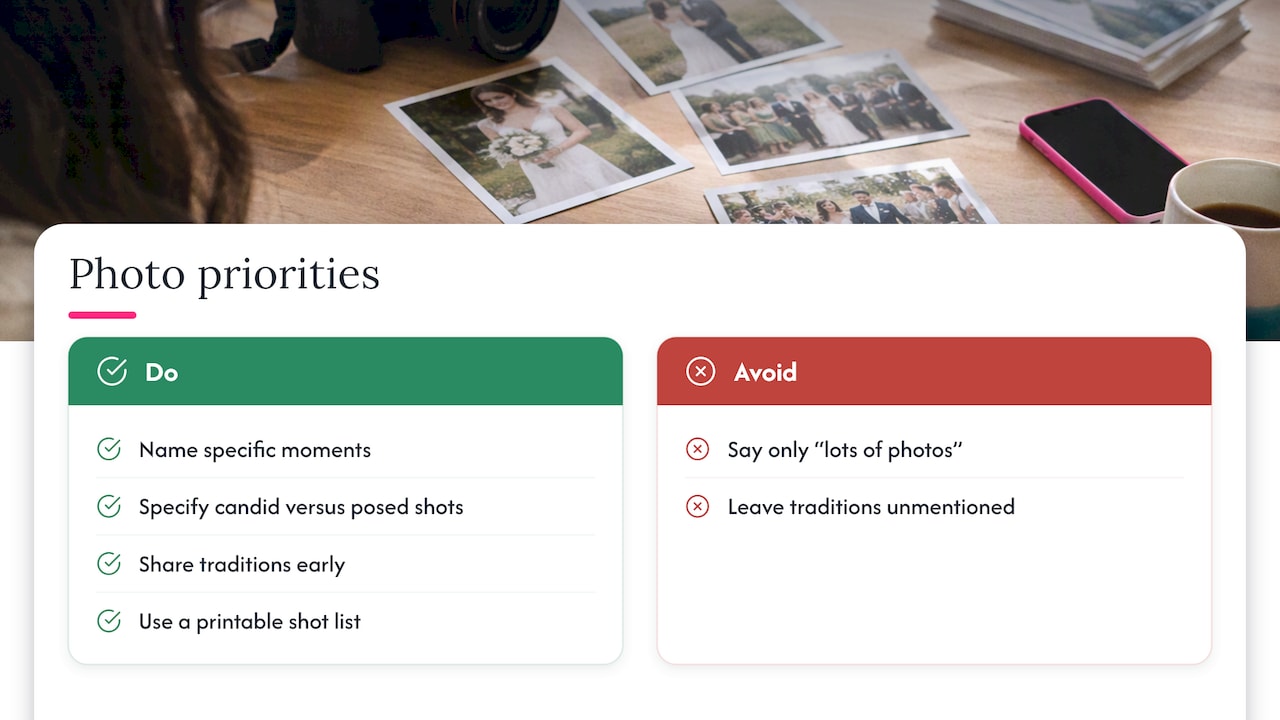
Numbers are a useful shorthand, but what you really want is a gallery that reflects your priorities, not just a headline figure. Before your wedding, talk through the moments that matter most: the quiet seconds before you walk down the aisle, a particular family grouping, the first dance, or the way your venue looks as the light changes in the evening.
Be specific rather than general. “We want more candid reception shots and fewer posed family groupings” gives a photographer something concrete to work with, far more useful than “we want lots of photos”. If there is a tradition, a blessing, or a detail specific to your families that an outside photographer might miss, say so early, ideally in writing alongside your shot list.
It also helps to flag what you do not need. If you are not fussed about formal portraits with distant relatives, say so, and that time can go instead towards documentary-style coverage of the parts of the day you actually care about. A printable shot list is a practical way to have this conversation, because it turns a vague wish into a document you and your photographer can both refer back to on the day itself.
7. Why more photos is not always the better outcome
A bigger number can feel reassuring, but a tightly edited gallery of 900 strong images usually serves you better than 1,800 images padded out with duplicates and near-misses. The rule of thumb we have used throughout this article, 100 to 150 edited photos per hour, is a guide to volume, not a measure of quality.
When you compare photographers, look at how they edit, not just how much they deliver. A photographer who culls heavily and hands you their strongest two hundred frames from a ceremony is not giving you less of your wedding, they are giving you a curated version of it. A photographer who delivers everything usable, including several near-identical shots of the same toast, is prioritising completeness over curation. Both are legitimate approaches, but they produce very different galleries from the same number of hours.
The safest way to judge this before booking is the same advice that runs through this whole piece: ask for a full sample gallery, not a highlight reel, and read it with an eye on consistency rather than sheer volume.
8. Matching your photo count to your wedding size and style
A 30-guest elopement and a 150-guest reception generate very different amounts of material, even at the same number of coverage hours, simply because there are more people and more moments to capture at a larger event. When you are discussing numbers with a photographer, bring your guest count and your venue layout into the conversation, not just your hours.
If your wedding spans multiple venues, for example a ceremony at one location and a reception elsewhere, factor in travel time, which eats into shooting hours without adding to your final count; consider also hébergement des invités à Salon‑de‑Provence for visitor accommodations that complement your destination celebration. A documentary-style wedding with minimal posed photography will naturally produce a different gallery shape than one built around a long, structured formal photo list, even if the total image count ends up similar.
It is worth raising your wedding’s specific shape directly: “we have two ceremonies in two different traditions” or “our reception runs until 1am” are details that change what a realistic gallery looks like, and a photographer who knows this in advance can set your expectations accurately rather than leaving you to compare against a generic average.
9. What different packages tend to deliver
Package names vary between photographers, but the hours attached to them are the clearest way to compare what you will actually receive. A short session or elopement package, typically a few hours, tends to sit at the lower end of the range discussed earlier in this article. A half day or full day wedding package scales up accordingly, and a full event package covering preparations through to the end of the reception sits at the upper end.
Among the queer photographers we represent, packages are built around the same logic: hours booked translate to a realistic expected gallery size, confirmed individually rather than promised as a blanket figure across every wedding. This is deliberate. A fixed number attached to every package regardless of guest count or venue complexity tends to either overpromise on quiet days or underdeliver on long, busy ones.
Whatever package you are considering, with us or elsewhere, ask the provider to translate their package into an expected number before you book, using your own hours and wedding shape rather than a generic average.
Ready to book a photographer who sets clear expectations
We make it straightforward to find a photographer who will talk you through a realistic photo count before you book, not after. Browse our wedding and event packages, which include Mini, Standard, Two hours, Half day, Full event, Elopement, Full day and Extended options, alongside video coverage if you want your day captured on film as well as in stills.
- Ask to see a full representative gallery from a photographer whose style suits you.
- Confirm your minimum edited-image count and the definition of “edited” in writing before the day.
- Request matching with a photographer within 24 hours through our booking process.
Personal brand packages start from £200, and every match is handled by a real person who understands what you are looking for.
FAQ
How many photos are normal for a wedding?
A typical full-day wedding of around 8 hours usually comes back with 800 to 1,200 edited images, occasionally reaching 1,500 with a second photographer. Shorter or longer coverage shifts that range up or down using the same hourly guide.
What is the 20-60-20 rule in photography?
The 20-60-20 idea is a composition and attention heuristic used in some photography discussions, not an industry standard for how many photos a wedding photographer must deliver. According to UK wedding photography guidance, it should never be treated as a contractual gallery-count rule unless your photographer explicitly defines it that way.
How many photos for a 3 hour wedding?
A 3 hour wedding, such as a short elopement, typically yields around 300 to 450 final edited images, based on the common 100 to 150 images per hour rule of thumb. The exact number still depends on your photographer’s editing style and how much happens within those hours.
Is 500 photos enough for a wedding?
500 images is usually enough for a shorter or more intimate wedding, but it can feel light for a full day that includes a reception, speeches and dancing. If your coverage runs 8 hours or more, ask your photographer directly whether 500 reflects their typical delivery for that length of day.
Sources
- How Many Photos Should a Wedding Photographer Give? (2026 Guide)
- Choosing a wedding photographer — Vows & Venues (UK)