
Queer Family Photo Ideas for Portraits That Feel Like You
The best queer family photos are not the ones with the neatest poses. They are the ones where everyone in the frame is recognisably themselves: the kitchen as you actually use it, the dog who refuses to sit, the friend who has been family for fifteen years. This guide gives you ideas for places, poses, people and prompts, plus a plain way to brief a photographer so the day goes your way.
We are Queer.Photo, a London agency that matches people with vetted queer photographers, so a lot of what follows comes from the kind of conversations we have before a shoot.
TL;DR
- Start with who is in your family, not with a pose list. Two mums, three dads, a chosen family, a parent and their grown-up kids: all of it counts, and the frame should say so.
- Choose a place that is already yours: your flat, your street, a park you really use, or a quiet studio hour.
- Pick three or four moments to build the shoot around (a ritual, a game, a meal) and let everything else happen between them.
- Tell your photographer about names, pronouns, boundaries and anyone who should not be photographed or shared online before the day.
- Decide in advance where the images will go: the family wall, a group chat, or social media.
Table of Contents
- Start with the people, not the poses
- Where to shoot: five settings that suit queer families
- Poses and moments that feel genuinely yours
- Ideas for different kinds of queer family
- What to wear
- Making it work with children
- Privacy, safety and consent
- How to brief a photographer in ten minutes
- Choosing a photographer who understands
- Matching you with the right person
- After the shoot: what to do with the pictures
- FAQ
- Sources
Start with the people, not the poses
Most family photo advice assumes one shape of family. Search for ideas and you will meet stock images of a smiling pair of parents and two children in matching jumpers. Queer families are rarely that tidy, and the photos are better when they are not.
Before you save a single reference picture, write down who you want in the frame. It might be:
- Two mums or two dads with one child, or several.
- A trans or non-binary parent with their children.
- A polyamorous family of three or more adults.
- A single queer parent and their kids.
- Chosen family: the friends who show up to birthdays, hospital visits and Sunday lunches.
- Adult children and the parents who supported their coming out, or who are still finding their way there.
- A couple who are not parents yet, and may never be, with the dog or cat who runs the house.
There is no hierarchy here. The point of the list is to make sure nobody is quietly left out because a guide did not imagine them. If your family includes a polyamorous or chosen-family structure, we have a page on polyamorous and chosen family portraits in London that goes into how those sessions work.
Where to shoot: five settings that suit queer families
At home, as you arranged it
Home is where most of us are most ourselves, and it is often the most meaningful place to photograph a family. Think of the sofa where everyone piles on, the kitchen counter where homework is done, the bedroom where the weekend starts late. A photographer who works documentary-style will follow the ordinary rhythm of the place rather than staging it.
A few practical thoughts for a home shoot:
- Tidy only what would stress you out. A lived-in room reads as warm, not messy.
- Open curtains and switch off harsh overhead lights. Window light is kinder to every skin tone.
- Keep the fridge door, the bookshelf and the wall of drawings. Those are the details you will love in ten years.
- Tell your photographer which rooms are off limits.
Your own street and neighbourhood
A walk through the place you live says a great deal. The corner shop, the bus stop, the market, the local café that knows the children’s order. In London, this might be Hackney Marshes, a Lewisham high street, or the canal near Camden. A short loop of fifteen to twenty minutes is plenty. Let the children lead and the photographer will pick up the rest.
A park, a heath or the river
Open space is easy with young children because they can move. Look for somewhere with some shade and a quiet corner, and go at a time of day when it is not crowded, which also helps if anyone in the family feels self-conscious about being photographed in public. Early morning or the hour before sunset usually works best.
A quiet studio hour
A studio is a good choice if your home is small, if you want a clean backdrop for a framed print, or if you would simply rather not have a stranger in your private space. It also suits families who want something more portrait-like, with careful lighting and a bit of colour. Our queer studio portrait sessions in London are built for this.
A place that matters to your story
The café where you had your first date, the clinic you visited, the pub that hosted your adoption party, the community centre where your family found its people. Photographing a place that carries meaning gives the picture a second layer that only you will fully read.
Poses and moments that feel genuinely yours
Forget the stiff line-up. These prompts are designed to produce movement and real expression, and they work for any family shape.
The pile-up
Everyone on the sofa or bed at once, in whatever arrangement happens. Children climb on adults, adults lean on each other, pets find the warmest spot. It is chaotic and affectionate, and it usually produces the picture people choose for the wall.
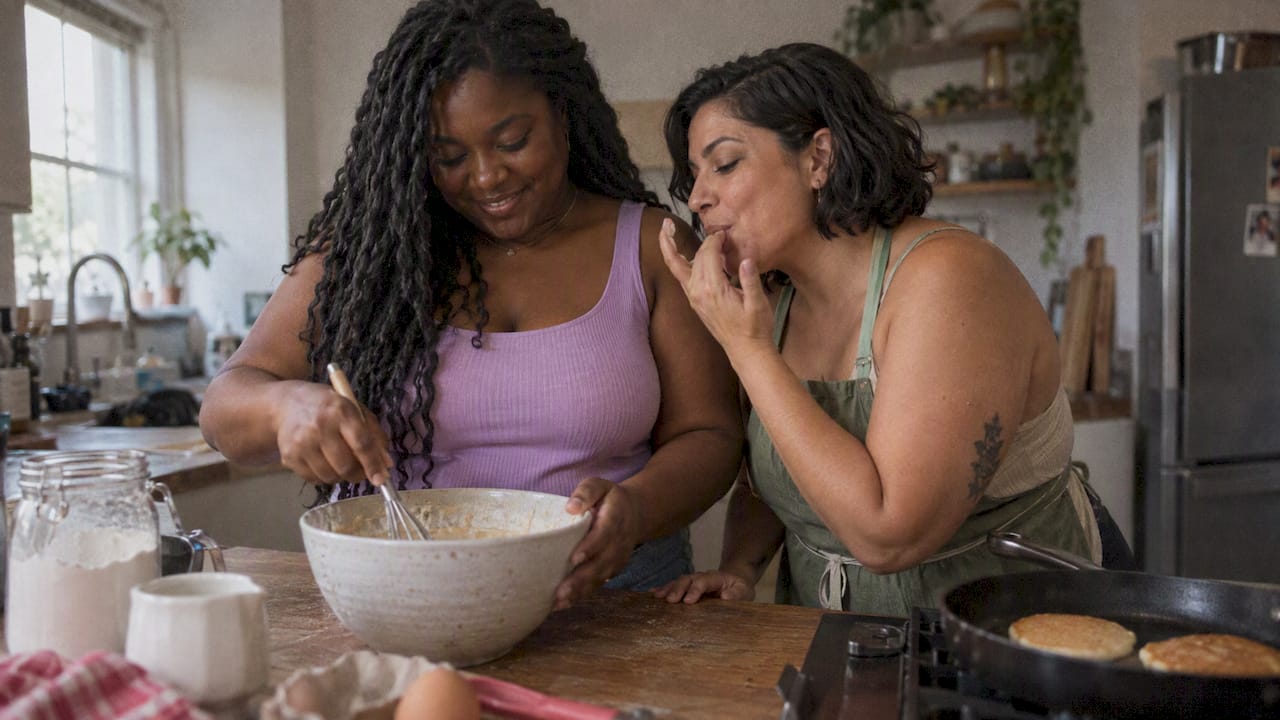
The kitchen ritual
Pancakes on Saturday, someone stirring, someone stealing a bite, someone checking their phone. Cooking gives everyone something to do with their hands, which is the quickest cure for photo stiffness.
Walking towards the camera
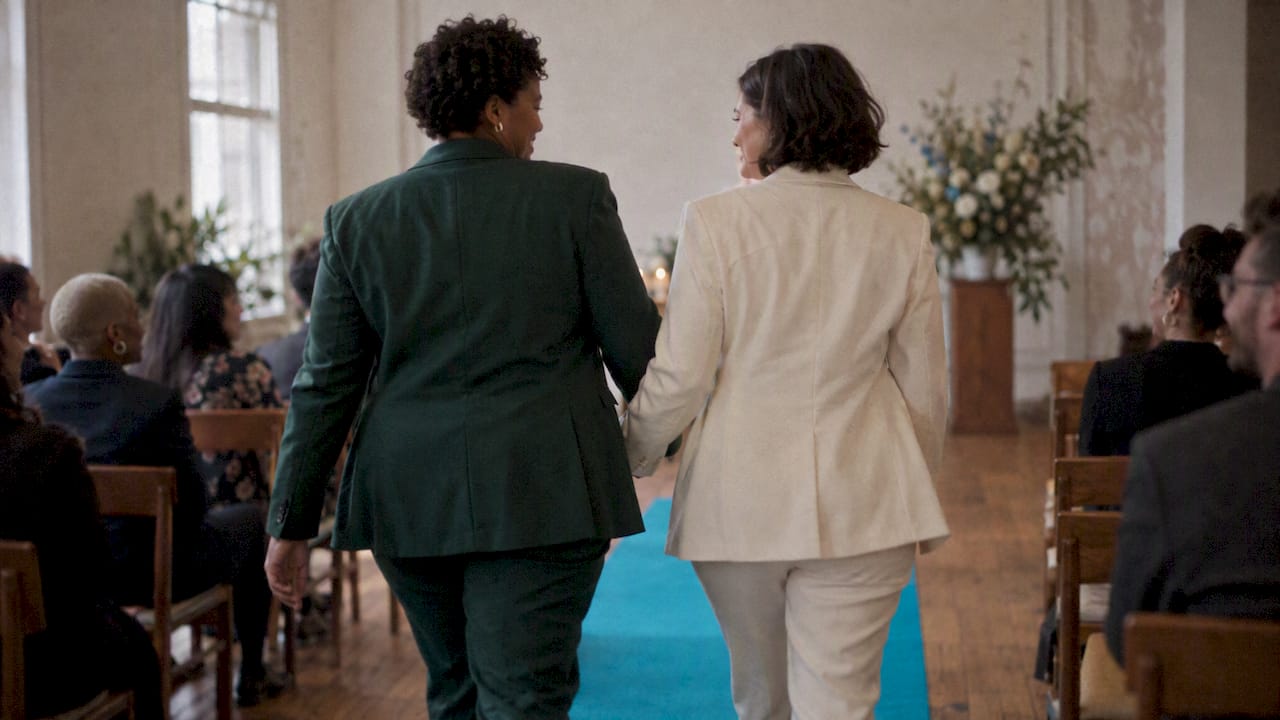
Hand in hand, or swinging a child between two adults, or the whole group strolling in step. Ask the photographer to shoot from a little distance so the setting stays in the frame.
The quiet pair
Two people in the family, one-to-one: a parent and child reading, partners leaning forehead to forehead, a grandparent and grandchild with the same grin. These close pairs often become the most treasured images of the lot.
The bedtime or morning hour
A gentle shoot in pyjamas, with tea, a book, or a half-asleep child. It is among the most intimate ideas on this list, so be clear with your photographer about what you are comfortable with. For families with children, we keep things simple and respectful: everyday life, nothing staged or revealing.
The full-family laugh
Ask everyone to say the worst joke they know, or to tell the photographer what the child did this week. Laughter is far more honest than a smile on command, and it does not depend on anyone’s gender, age or pose.
Props that mean something
Bring objects that carry your story: a pride flag draped over a chair, the first baby shoes, a pet’s favourite toy, a framed marriage certificate, the book that helped you decide to become parents. Keep them to two or three so they stay meaningful rather than decorative.
Ideas for different kinds of queer family
Same-sex parents with young children
The family structure is the point, so show it through ordinary affection rather than a labelled pose. Try a shot where each parent is doing something different with the children: one reading, one making a mess. Alternatively, a tight frame of hands, small and large, holding each other. Same-sex couples raising children are a growing group; a Dutch statistics office reported in 2026 that the number of same-sex couples with children in the Netherlands was six times higher than in 1995, a reminder that these families are part of everyday life, not an exception.
Trans and non-binary parents
The most important thing is to be named and pictured correctly. Share names, pronouns and anything about how you would like to be described in captions. Many trans and non-binary parents want pictures that feel simply like a family, without a story attached, and that is a perfectly good brief. If you would like a photographer with specific experience, our trans portrait photographers in London work this way every day, and we also cover trans portraits across the UK.
Polyamorous and chosen families
The question here is composition. With three or more adults and several children, group frames can look crowded or accidentally hierarchical. Ask the photographer to experiment with layers (some standing, some seated, someone on the floor) so that nobody is pushed to the edge. Include small groupings too: two adults together, then a different two, then everyone. It lets each relationship breathe.
Chosen family and friends
For many queer people, family is the group who stayed. A shoot with your chosen family might be dinner at a long table, a day out, or a flat full of people on a birthday. Aim for energy over perfection. If you are planning something bigger, such as a birthday, naming day or reunion, take a look at our LGBTQ family gathering photographer in London page.
Parents and adult children
Some of the most moving family sessions are with adult children and the parents who have grown alongside them. A walk, a meal, a portrait in the childhood home. Keep in mind that not every relative will be comfortable in front of a lens, or comfortable being identified publicly. Let people opt in at their own pace.
Couples, pets and the family you are building
Not every queer family has children. A couple with two cats and a big plant collection is a family too. For couples, our queer couples photographer in London page covers the options, and if a wedding is on the horizon, our LGBTQ+ wedding photo ideas guide shows how to carry the same approach into the day itself.
What to wear
Wear what you would wear to a good day out, only slightly more considered. A few simple principles:
- Choose a palette, not a uniform. Two or three colours that sit well together beat everyone in the same white shirt.
- Prioritise comfort. Children (and adults) relax in clothes they can move in.
- Let identity show. If a bold jacket, a binder, a harness, a badge or a favourite pair of boots feels like you, wear it.
- Avoid heavy logos. They date a picture quickly and draw the eye away from faces.
- Bring a spare layer. A cardigan or a scarf can change the mood of a frame in a minute.
If you plan to frame a print, think about the wall it will hang on. A warm tone in a cool room looks wonderful; a perfect match can look flat.
Making it work with children
Children are the best argument for a relaxed approach. A few things that help:
- Book around their energy. Mornings suit toddlers; after school suits older children.
- Keep it short. Forty-five minutes of attention is better than two hours of fatigue.
- Give them a job. Holding a leaf, carrying the picnic blanket, pointing out the dog.
- Tell them in advance what the photographer will do, and that they can say if they want a break.
- Do not bribe heavily. A small snack is fine; a negotiation is not a photograph.
Images of children carry extra responsibility. If your child is at school, bear in mind that schools often have their own image policies, which typically ask for written permission before pictures of pupils are used or published, as one UK school policy sets out. That applies to a school’s own use; for your own family album, the Information Commissioner’s Office explains that data protection law does not stop parents taking photos for purely personal or household use. Where families care most is on social media, which leads to the next section.
Privacy, safety and consent
For queer families, visibility is a choice and sometimes a risk. A relative may not know, an ex may be unsupportive, a child may not want their face online. Think these through before the shoot, not after.
Talk with your photographer about:
- Who can appear. Name anyone who should not be photographed, or who should only be photographed from behind or in detail shots.
- Where images will be shared. Family album only, a private gallery, or public posting. Agree it in writing.
- Names and captions. Give names and pronouns exactly as you want them used, and decide whether children’s names are mentioned at all.
- Portfolio use. Many photographers like to show their work. You are entitled to say yes, no, or only with certain pictures.
- Location tags. Avoid geotagging your home or your child’s school.
Good practice in this area is well established. Guidance on ethical image-making for charities says that people who may have experienced stigma or trauma deserve extra sensitivity in how content is produced, as set out by the sector body Bond. Industry guidance for LGBTQ+ wedding vendors also says that professionals should listen carefully and respect boundaries when families include chosen relatives, unsupportive relatives or safety concerns around visibility. A photographer should expect this conversation. If they bristle at it, that tells you something.
There is also an academic angle that families sometimes find reassuring: research on collaborative photography with trans partners argues that when participants help shape the images, the result can show intimacy beyond what text alone can say. In plain terms, a shoot goes better when you are a co-author, not a subject.
How to brief a photographer in ten minutes
You do not need a mood board the size of a wall. A good brief fits on one page. Try this:
- Who is coming. Names, ages, pronouns, any access needs.
- What the day is for. A birthday, an adoption anniversary, a new baby, a gift for grandparents, or just because.
- Where. Home, outside, studio, or a place with a story.
- Three moments you want, such as breakfast, the walk to the park and a family laugh.
- Two or three reference pictures that feel right, plus one that feels wrong.
- Boundaries. What is off limits, who must not be shared, and what you are not comfortable with.
- Where it goes. Print, private gallery, social media.
- Timing. How long you have, when the children need a break.
A photographer who has read this will arrive knowing how to treat you. It also helps to see an overview of how professionals organise their images after the shoot. If you are curious how your final gallery gets sorted, selected and delivered, this photography workflow guide walks through the steps in plain language.
One more point on style. Some families prefer documentary (the photographer follows and rarely directs), some prefer portrait (more composed, with light and posing), and many like a mix. Neither is better. Say which you lean towards, and be honest if you hate being told where to stand.
Choosing a photographer who understands
The photograph is only as good as the trust in the room. Look for someone who:
- Asks about your family before they ask about your budget.
- Uses the right words without being corrected twice.
- Shows work that includes families like yours, not only couples.
- Explains how images are credited, stored and shared.
- Is happy to talk through boundaries, plans and fallbacks.
It can help to hear from queer creatives themselves. One queer videographer says her aim is to create a space where you feel affirmed and seen, and that sentence is a good test for any photographer: would you feel that way in the first conversation?
We cover the longer version in our guide to what an LGBTQ family photographer in the UK costs, and our queer family portrait photographers in London page shows how sessions are shaped.
Matching you with the right person
If you would rather not trawl through portfolios, that is what we do. At Queer.Photo every photographer on the roster is vetted and personally represented, and a real person (not an algorithm) matches you with the right specialist, often within 24 hours. All our imagery is original, never stock or AI generated, and every shoot respects pronouns and personal boundaries, with proper credit given to the photographer.
You can see the packages and how they work on our prices page, or meet the photographers and tell us about your family. If you would like moving pictures as well, our video services cover that too.
After the shoot: what to do with the pictures
A folder on a hard drive is not a family album. A few ways to make the pictures live:
- Print one large image for the wall, in a frame that suits your room.
- Make a small album of 20 images, with captions in your own words.
- Send a private gallery link to relatives who are supportive, and ask them to keep it private.
- Give a framed pair to grandparents or chosen family.
- Keep a yearly habit. A short shoot every birthday builds a story over time, and the changes in the children tell it better than any caption.
FAQ
What are good poses for a queer family photo?
The best poses are activities rather than line-ups: a sofa pile-up, a walk with a child swinging between two adults, a kitchen ritual or a shared joke. Give everyone something to do and the photographer will capture natural interaction. Add one or two simple close pairs, such as parent and child reading together, for the quieter frames.
How do I make an inclusive family photo if my family is not a couple with children?
Start with who is in your family, then build around them. Chosen family, polyamorous households, single parents, adult children and pets can all be framed with layered groupings, small pairings and a whole-group shot. Tell your photographer in advance how you describe your relationships so nothing is mislabelled.
Can I keep our family photos private?
Yes. You can agree with your photographer that images are delivered through a private gallery and not used in a portfolio or on social media. Put this in writing before the shoot, name anyone who should not be identified, and avoid location tags on anything you share yourself.
Should we shoot at home or somewhere else?
Home gives the most personal pictures and is easiest with young children. A park or your own street adds variety, and a studio gives a clean, controlled setting if you want a framed portrait or prefer not to host. Many families do one main setting plus a short walk.
How long should a family shoot last?
For families with young children, 45 to 60 minutes of actual photography is usually enough. Older children and adults can manage longer if the pace stays relaxed. Your photographer can suggest a length once they know the ages and the setting.
Sources
- Supplier spotlight: queer videographer Naomi Ellison
- Rainbow Wedding Network vendor guidelines
- Bond: Putting the people in the pictures first
- Imag(in)ing Trans Partnerships: Collaborative Photography and Intimacy
- ICO: Taking photos in schools
- School Image Use Policy, January 2025
- CBS: Number of same-sex couples with children six times higher than in 1995