Corporate Event Photography Brief: What to Put in It
A good corporate event photography brief fits on one or two pages and answers five things: why the event is happening, which moments matter most, where and when everything takes place, how the images will be used, and what the photographer needs to know about your people. Send it a week or so before the day, and you will get pictures you can use instead of pictures you have to explain.
We work with companies in London every week, and the pattern is familiar. The events that photograph well are rarely the biggest or the best funded. They are the ones where somebody wrote down what mattered.
TL;DR
- Open the brief with the purpose of the event and where the images will end up, not with the schedule.
- Name three to five must-have shots and one named contact on the day. Everything else is a bonus.
- Put usage rights in writing: in the UK the photographer owns the copyright unless the contract says otherwise.
- Tell attendees they will be photographed, and say how they can opt out.
- For diverse or LGBTQ+ events, brief for dignity and context, not a quota of faces.
Table of Contents
- Start with the purpose, not the programme
- The practical details a photographer cannot guess
- Name the shots that must exist
- Say how the images will be used, and get it in writing
- Photographing people: consent and notice
- Briefing for inclusive, honest imagery
- Tone and style: show, don’t adjectives
- Delivery: what you get and when
- A one-page template you can copy
- Matching the right photographer to the brief
- Common mistakes to avoid
- FAQ
- Sources
Start with the purpose, not the programme
Most briefs begin with a timetable. Start one step earlier. A photographer who knows why the event exists makes a hundred small decisions correctly without asking you.
Write two or three sentences covering:
- What the event is. A staff Pride celebration, a client dinner, a conference, a product launch, an awards evening.
- What the images are for. The intranet, LinkedIn, a press release, an annual report, a sponsor deck, recruitment pages.
- Who will see them. Employees, clients, investors, the wider LGBTQ+ community, journalists.
- What you want people to feel. Warm and busy, polished and serious, relaxed and a bit mischievous.
Compare two sentences. “Photograph our Pride reception” gives a photographer nothing. “Our Pride reception is the main image source for next year’s careers page, so we need real colleagues talking and laughing, not lined-up groups” changes how they work all evening.
If you have used a short structure before, our 5-point photography brief template is a quicker version of the same thinking, and it helps you get quotes back faster.
The practical details a photographer cannot guess
This is the part that stops the day going wrong. Keep it factual and put it in a list so it can be read on a phone on the way to the venue.
| Detail | What to include |
|---|---|
| Venue | Full address, loading and entry instructions, which floor, lift access |
| Timings | Arrival time, doors, speeches, awards, food, close, ideally in 30-minute blocks |
| On-day contact | One named person with a mobile number who can answer without a meeting |
| Light and space | Is the room dark, is there a stage, are there windows, is there a quiet corner for portraits |
| Dress code | What the photographer should wear so they blend in |
| Access | Step-free routes, accessible toilets, quiet spaces |
| Delivery | Deadline, format, how many images, how you will receive them |
The evening runs on London time, which means it will probably start late and the speeches will overrun. Tell the photographer which moments are fixed (the CEO’s remarks, the award handover) and which can slide. That way they are in position for the first and relaxed about the second.
If you can, send the run sheet itself as well as a summary. Photographers read run sheets differently from the people who wrote them, and they will spot where two key moments overlap.
Name the shots that must exist
Three to five must-haves is the right number. Ask yourself: if this frame were missing from the gallery, would we feel the event had not been covered?
Typical candidates:
- The keynote speaker with the audience visible behind them.
- The headline guest or award winner at the moment of recognition.
- A wide room shot showing scale and atmosphere.
- Sponsor or partner branding, shown naturally rather than staged.
- Candid conversation between people who do not usually meet.
Then add a short “nice to have” list: details of the food, the venue, hands, laughter, the quiet moments at the edges. A longer list is fine as long as the must-haves are clearly marked. When everything is a priority, nothing is.
For a fuller prompt list you can copy, see our event photography shot list, which also covers consent wording for UK events.
Say how the images will be used, and get it in writing
This is the line most briefs leave out and most disputes come from. In the UK, the photographer owns the copyright by default unless a written agreement says otherwise. Paying for a shoot does not transfer ownership. You receive the rights that your contract or licence grants, so scope matters.
In the brief, state the uses you already know about:
- Internal communications and intranet
- Your own website and social channels
- Paid advertising
- Press and PR
- Print, such as an annual report or event signage
- Sponsors or partners reusing the images
Also say how long you want to use them. “Perpetual, worldwide, all company channels” is a different quote from “social media for twelve months”, and the photographer will price accordingly. A short quote that covers the real uses is always better than a surprise conversation later.
You may want to ask for a written agreement even for a simple one-evening job. If your legal team is involved, it helps to give them the general principles on copyright ownership from GOV.UK before they draft anything. Note that the GOV.UK page covers several situations, including works made by employees, so check which applies to your arrangement.
Photographing people: consent and notice
If someone can be recognised in a photograph, it is usually treated as their personal data. That means you need a lawful basis for taking and publishing it. The ICO’s page was written for schools, but the principle is the same for any organisation.
Consent is one lawful basis, not the only one. For many corporate events, organisers rely on legitimate interests for promotional images, provided attendees are told in advance and there is a clear way to opt out. One local authority’s privacy notice shows the pattern: signage, photography-free areas, and the option to tell the organiser. A company can follow the same logic.
Practically, your brief should tell the photographer:
- What attendees have been told, and when (in the invitation, on the registration page, on signs at the door).
- Whether there is a photography-free area or a quiet room.
- A way to recognise people who have opted out, such as a coloured sticker or lanyard.
- Which people need a closer conversation before they are photographed, such as speakers’ guests, people who are not out at work, or staff attending under a private arrangement.
That last point deserves extra thought at an LGBTQ+ event. Being photographed and published can reveal something about a person that they have not shared with everyone. A clear opt-out and a photographer who asks before publishing close-ups are a basic courtesy, not an extra. If you are unsure about the legal position for your particular event, speak to your data protection officer or legal adviser before the day.
Briefing for inclusive, honest imagery
Companies often write “we want diverse imagery” and leave it there. It is a good intention that tends to produce a staged group of people standing together in front of a banner.
The Business Disability Forum’s guidance on commissioning images makes a useful point that carries over to any underrepresented group: include people in your general imagery, not only in material about their identity. It also advises showing a broad range rather than one type of person. Its guidance is about disability, but the thinking applies when you commission any inclusive coverage.
In practice, put these things in the brief:
- Real people, real roles. Ask for colleagues and guests as they are, not cast extras. Do not ask anyone to perform an identity.
- Angles and framing. Tell the photographer you want people photographed as equals. For example, a wheelchair user should not be shot from an awkward or patronising angle.
- Pronouns and names. Share a list of names and pronouns for speakers and key guests, if people are happy for you to do so, so captions are right the first time.
- Access needs. Describe the venue’s accessibility honestly and let the photographer say what they need, too. Accessible toilets and rest breaks matter for the people behind the camera as well.
- Talk to people directly. Questions go to the person, not their colleague or support worker.
There is a difference between a brief that says “include a range of people” and one that says “cover everyone who is there, with the same care”. The second is much easier to deliver, and the pictures show it.
If your event is a workplace Pride celebration, we have written separately about avoiding token shots at corporate LGBTQ+ events, and we cover that kind of work on our workplace Pride event photographer page.
Tone and style: show, don’t adjectives
“Natural, authentic, professional” appears in half of all briefs, and it tells a photographer almost nothing. Replace adjectives with references.
- Send three to six images you like, from past events of your own or elsewhere, and add one line on what you like about each.
- Send one or two you do not want, again with a reason. “Too posed” or “too dark” is enough.
- Say whether you want colour or black and white, bright and airy or moody, wide documentary or tighter portraits.
- Mention your brand colours only if they matter for the framing, such as a backdrop or stage design.
Also decide on how much direction you want. Some events benefit from a documentary approach, where the photographer stays out of the way. Others need ten minutes of organised portraits at a set time. You can ask for both, but say when the portrait window is and who is responsible for gathering people into it.
Delivery: what you get and when
A brief should end with what happens after the event. Decide this before you request quotes, because it affects price and planning.
- Quick selects. A small batch of edited images within 24 to 48 hours, useful if you want to post on social media or send a press note the next day.
- Full gallery. The complete edited set, often within a week or two. State the date you need it.
- Format and size. Web-size files for social, high-resolution for print. Say if you need both.
- Access. An online gallery with download rights for named colleagues, or a shared drive.
- Captions. Whether the photographer should note names, and who will check them.
- Credit. How the photographer should be credited when images are published. Proper credit is part of the deal with us, and it is easy to agree up front.
You can also ask whether raw files are included. Most professional photographers do not hand over unedited files, so check this early rather than assuming.
A one-page template you can copy
Paste this into an email, fill it in, and send it a week before the event.
Event: name, date, venue address
Purpose: one or two sentences on why it is happening
Audience for the images: internal, clients, press, community
Uses and duration: channels and how long (for example, website and social for twelve months)
Must-have shots (3 to 5): list them
Nice to have: list them
Timings: arrival, key moments, finish
On-day contact: name and mobile number
Consent and notice: what guests have been told, how to opt out, any no-photo areas
People notes: names and pronouns where shared, access needs, anyone needing a conversation first
Style references: three to six images you like, one or two you do not
Delivery: first selects, full gallery date, format, how you will receive them
Budget: a figure or a range, so the photographer can propose what fits
Then finish with a ten-minute call the day before. It is the cheapest insurance in event planning.
Matching the right photographer to the brief
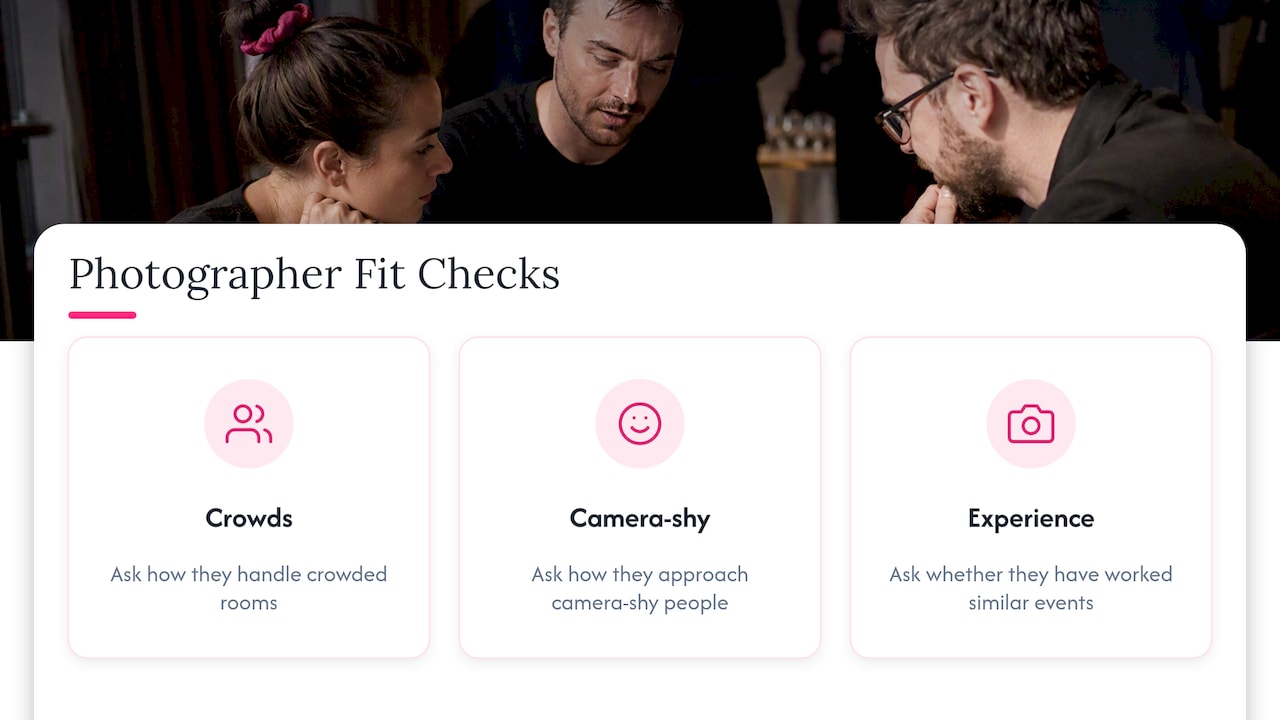
The best brief in the world still depends on the person holding the camera. Ask whoever you are considering how they handle crowded rooms, how they approach people who are shy of the camera, and whether they have worked at events like yours before.
At Queer.Photo, a real person reads your brief and matches you with a vetted photographer, often within 24 hours, rather than leaving you to sift through a directory. Every photographer on our roster is personally represented by us, and all the imagery is original: never stock, never AI generated. Shoots respect pronouns and personal boundaries, and photographers are properly credited.
If you are planning something in London, start with our queer event photographer in London page and send your brief through it. You can see how packages are set out on our prices page, and if the event needs film as well as stills, our video services cover that. For a conference, there is a dedicated page for an inclusive conference photographer in London.
Common mistakes to avoid
- Sending the brief the day before. A week is the sensible minimum; two is better for large events.
- Listing twenty must-haves. The photographer will chase all of them and nail none.
- Forgetting the quiet moments. Setup, arrivals and the last conversation at the door often produce the best pictures.
- Leaving usage vague. Say what you plan to do with the images, now, in writing.
- Treating inclusion as a quota. Brief for how people are shown, not for how many boxes are ticked.
- Not briefing your own colleagues. Tell staff a photographer will be there, and who they are.
FAQ
How long should a corporate event photography brief be?
One to two pages is enough for most events. Put the purpose, must-have shots, timings, contact and usage at the top, and attach the run sheet separately. A photographer who can read it in five minutes is more likely to use it properly.
How far in advance should I send the brief?
Aim for at least a week before the event, and earlier for conferences or multi-room venues. Follow up with a short call the day before to confirm timings and any last-minute changes. Booking the photographer sooner is wise too, since popular dates fill up.
Who owns the photos from a corporate event?
In the UK, the photographer owns the copyright by default unless a written agreement says otherwise. You receive the rights your contract grants, so list the channels and duration you need. If your use is wide or unusual, ask a solicitor to check the wording.
Do I need consent from every guest at my event?
Not always. Consent is one of several lawful bases under UK data protection law, and organisers often rely on legitimate interests for promotional images if guests are told in advance and can opt out. For sensitive events, or where someone may not be out at work, ask first and take advice from your data protection lead.
What should I say in the brief about diversity?
Say how you want people to be shown, not just who you want in frame. Ask for real colleagues and guests, equal framing, correct names and pronouns, and honest access information. Avoid asking anyone to act out an identity for the camera.
Sources
- Photography Contract Clauses and Legal Tips in the UK, Sprintlaw
- Ownership of copyright works, GOV.UK
- Taking photographs: data protection advice for schools, ICO
- Photography and Filming (Public Events) Privacy Notice, Dartford Borough Council
- How to select, commission and use disability-smart images, Business Disability Forum