
Image Usage Rights in the UK: Five Licence Terms to Record Before Publishing
You may not reuse an online image without permission. Copyright protects photographs automatically from the moment they are taken, so finding a picture is never the same as being allowed to use it. The safe route is a written licence that names your exact use, or commissioning original work so there is no licence to chase in the first place.
TL;DR:
- Before publishing, get a signed written licence that names the exact use, media, territory, duration, fees, attribution, modification rights, and whether you may sublicense.
- Royalty free licences often allow reuse after one payment, while rights managed licences restrict time, place, or campaign; check the exact Creative Commons variant.
- UK exceptions cover private study, criticism, review, and limited quotation, but commercial publishing generally needs permission; American fair use does not apply.
- Print permission does not automatically cover websites, social media, email, or video; confirm online and synchronization rights, and check whether edits are permitted.
- For identifiable people, document a lawful data protection basis and obtain a release recording intended uses, media, duration, and signatures, including a guardian for minors.
Table of Contents
- Types of licences you will meet and what each allows
- Who owns copyright and what moral rights mean for your use
- When you can reuse images without a licence: the exceptions and their limits
- How to licence an image: the checklist and contract terms you must record
- Orphan works and the Intellectual Property Office licensing scheme
- Model releases and data protection: consent when people appear in images
- Commissioning original images to avoid licence complexity
- Personal, editorial and commercial use are not the same thing
- How going digital changed what a licence has to cover
- Sync rights, print rights and online rights: what each term actually means
- Handling derivative works and image modifications
- How long a typical image usage agreement runs
- Book a rights-cleared shoot instead of chasing a licence
- FAQ
- Sources
Types of licences you will meet and what each allows
Once you start looking for images properly, you will hit a handful of licence types, and they are worth knowing apart because they cover very different situations.
Royalty-free does not mean free. It means you pay once for a licence and can reuse the image across a defined set of uses without paying again each time, which suits a blog post, a social graphic, or a simple web banner. Rights-managed works differently: you pay for a specific use, in a specific place, for a specific period, and if your campaign grows or runs longer than planned, you go back and pay again. Advertising campaigns with a defined media spend often sit here, because the owner wants to price the use to its reach.
Creative Commons images sit in a different category again. Some variants allow commercial use freely, others are marked “non-commercial” or “no derivatives”, which rules out editing the image or using it to sell anything. Reading the specific CC variant matters more than seeing the CC badge itself.
Whatever licence you are offered, a few terms decide what you can actually do with it:
- Duration: how long the licence lasts, and what happens when it ends.
- Territory: which countries or regions the use is permitted in.
- Permitted media: web, print, broadcast, or all of these.
- Exclusivity: whether others can also licence the same image while you use it.
- Sublicensing: whether you can pass rights on to a client or partner.
Skim past any of these and you risk using an image in a way the licence never covered.
Who owns copyright and what moral rights mean for your use
In most cases, the photographer who pressed the shutter owns the copyright from the start, unless they took the photo as an employee (in which case their employer usually owns it) or unless they have signed it away. That second point trips people up constantly: having the file is not the same as owning the copyright in it.
A licence and an assignment are not the same thing, and the difference changes what you are legally allowed to do:
- A licence gives you permission to use the image under agreed terms. The photographer still owns it.
- An assignment transfers ownership of the copyright itself, usually in writing, so you become the owner.
- Most commercial photography arrangements are licences, even when a client assumes otherwise.
Alongside ownership sit moral rights, which belong to the creator personally and cannot be sold or signed away, even when the economic rights are. These include the right to be credited as the creator and the right to object to the image being altered or presented in a way that damages their reputation, and the IPO’s guidance on the rights granted by copyright is clear that these rights survive a transfer. If you have commissioned a wedding shoot, our piece on contract clauses for securing photo rights walks through how ownership and moral rights typically get handled in that kind of agreement.
When you can reuse images without a licence: the exceptions and their limits
There are narrow situations where you do not need a licence, but they are far narrower than most people assume. GOV.UK’s guidance on using someone else’s intellectual property sets out that you need either a licence, ownership of the copyright, or a statutory exception, and the exceptions were never designed to cover everyday commercial reuse.
The permitted acts that commonly apply to images include:
- Private study and non-commercial research, for personal learning rather than publication.
- Criticism or review, where the image itself is the subject being discussed.
- Quotation, in limited circumstances, where the use is genuinely incidental to commentary.
Each of these has a practical test attached. If you are selling something, building a brand, or publishing to attract an audience for commercial gain, you are almost never inside an exception, however tempting it is to call a blog post “educational”. A useful habit: ask whether your use would exist at all without the image, and whether you are making money, directly or indirectly, from publishing it. If either answer points towards commercial use, assume you need a licence.
It is worth saying plainly that UK exceptions are not the same as the American concept of “fair use”. That doctrine does not apply here, and assuming it does is one of the most common and costly misunderstandings in image licensing.
How to licence an image: the checklist and contract terms you must record
Before you pay for any image, or sign off a photographer’s quote, get the following in writing. This is the list we ask clients to work through whenever a licence, rather than a commission, is on the table.
- Scope of use: exactly what you intend to do with the image (website, print run, advertising, social).
- Media: whether the licence covers digital, print, broadcast, or all three.
- Territory: the countries where you are permitted to publish.
- Duration: the start date and end date, or whether it is perpetual.
- Exclusivity: whether you are the only licensee or one of several.
- Attribution: how and where the creator must be credited.
- Moral rights: whether the creator has waived the right to object to edits, or retains it.
- Sublicensing: whether you can pass the image to a client, agency, or printer.
- Fees: the agreed price and whether extended use triggers additional charges.
- Indemnities: who is liable if the image turns out to infringe someone else’s rights.
If you need more than the licence currently covers, such as a longer run or a new territory, ask for it before you publish rather than after. Extending scope later is usually priced as an add-on, and it is far cheaper to negotiate everything at once than to go back mid-campaign.
Pro Tip: Always get the licence in writing and signed. GOV.UK’s guidance on licensing copyright material notes that a written, signed agreement is the reliable way to avoid disputes, since an implied licence offers no real certainty if a disagreement arises later.
Orphan works and the Intellectual Property Office licensing scheme
Sometimes you want to use an image where the copyright owner cannot be found or identified, known as an orphan work. The Intellectual Property Office runs a licensing scheme for exactly this situation, but it comes with real conditions attached.
Before applying, you must carry out and document a diligent search for the owner, covering the obvious registries, metadata, and reasonable enquiries:
- Check image metadata and any accompanying captions or credits.
- Search relevant copyright registers and photographer directories.
- Keep a record of every search step, since the application requires evidence of it.
If your search comes up empty, the resulting licence is UK-only, non-exclusive, and can run for up to seven years, after which it can be renewed. It is a genuine route forward, but it is not a shortcut around finding the actual owner first.
Model releases and data protection: consent when people appear in images
A photograph of an identifiable person is personal data under data protection law, not just a creative asset, and that changes what you need to collect before publishing it. The IPO’s own guidance on copyright and GDPR for photographers notes that consent is one of several lawful bases for processing, alongside contract and legitimate interest, and that whichever basis you rely on needs to be documented, not assumed.
A proper model release should record:
- Who is in the image, with full names.
- What the image will be used for, in plain terms.
- Scope, meaning which media and how long the consent covers.
- Date and signatures from everyone pictured, or a parent or guardian for a minor.
We built a practical ICO-aligned model release checklist covering each of these fields, so you are not drafting one from scratch when a shoot is already booked.
Commissioning original images to avoid licence complexity
Commissioning a shoot sidesteps most of this entirely, because you agree rights and releases upfront rather than chasing a licence after the fact. Every booking comes with a clear conversation about what you need the images for, so the contract and any model releases are written around your actual use from day one. Our mood board guidance is a good starting point if you are briefing a photographer for the first time and want the rights conversation settled before the shoot, not after.
Personal, editorial and commercial use are not the same thing
The same photograph can carry very different permissions depending on how you intend to use it, and licences are usually written around this distinction rather than around the image itself.
Personal use typically covers private, non-published use, a family print or a desktop background, and is the least restrictive category because nobody but you ever sees the result. Editorial use allows publication in a journalistic or informational context, reporting on an event or illustrating a news story, but it generally cannot be used to sell a product or imply endorsement, which is why you will often see “editorial use only” stamped across a stock photo of a recognisable brand or public figure. Commercial use covers anything tied to selling, advertising, or promoting a business, and it is the category that most often requires a full licence with model releases in place, because the image is doing marketing work rather than illustrative work.
Mixing these up is a common and expensive mistake. An editorial-licensed photograph of a crowd at a festival might be perfectly fine for a news article but entirely unsuitable for a brand’s advertising campaign, even if nothing about the image itself has changed. Before you publish, ask plainly which category your use falls into, because the answer decides which licence you actually need.
How going digital changed what a licence has to cover
Licensing used to assume a predictable print run or a single broadcast slot. Online publication broke that assumption, because a single upload can be shared, screenshotted, resized, and reposted far beyond the platform you originally published it on.
This is part of why modern licences increasingly specify digital use explicitly, sometimes breaking it down further into website use, social media use, and email marketing use, each with its own duration and territory. A licence written only for “print” years ago may say nothing about online use at all, which means republishing an old print-licensed image online can put you outside your agreement without you realising it.
It is also why many licensors now price perpetual digital rights differently to fixed-term print rights: a web image can theoretically be viewed indefinitely by anyone, anywhere, which is a much broader exposure than a magazine with a known print run and distribution area. When you are agreeing terms for anything destined for a website or social feed, check that “online use” is named specifically rather than assumed.
Sync rights, print rights and online rights: what each term actually means
Licensing contracts throw around terms that sound similar but cover distinct uses, and mixing them up is an easy way to end up outside your agreement.
Print rights cover reproduction in physical media: magazines, brochures, posters, packaging. A licence limited to print rights does not automatically extend to a website, however natural that leap feels.
Online rights cover digital publication: websites, apps, social platforms, email. These are often priced and time-limited separately from print, partly because of the reach difference discussed above.
Sync rights (short for synchronisation rights) apply when an image, or more commonly a piece of music, is paired with moving footage, such as a photo used in a video montage or slideshow. If your project involves video at all, check whether the licence you hold actually extends to synchronised use, because a still-image licence does not automatically cover this.
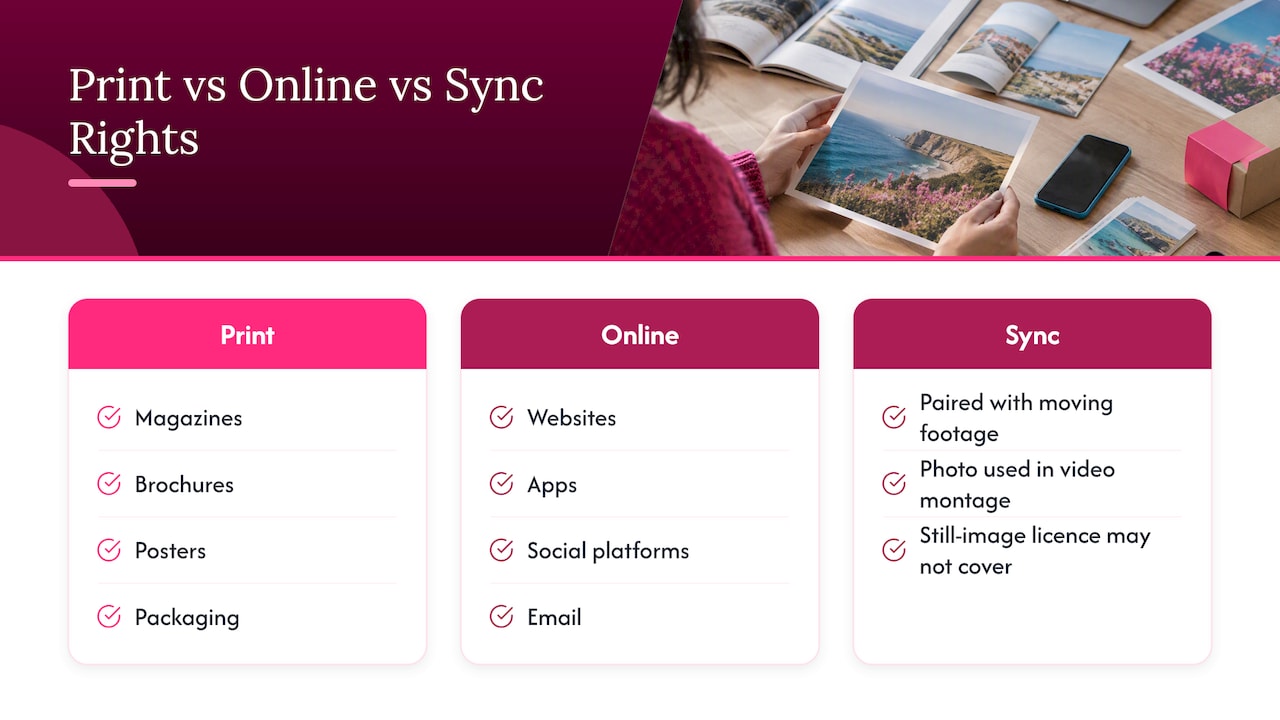
Treat each of these as a separate permission to confirm, not a single bundle that comes with any image licence by default.
Handling derivative works and image modifications
Editing, cropping, recolouring, or combining a licensed image with other elements usually creates what copyright law treats as a derivative work, and the original licence does not automatically grant you the right to make one.
Some licences explicitly permit modification, others restrict it entirely, and Creative Commons variants marked “no derivatives” rule it out completely, however minor your edit might feel. Beyond the licence terms themselves, moral rights come back into play here: even where modification is technically permitted, the IPO’s guidance confirms that a creator can still object if the result is derogatory to their reputation, because that right cannot be waived away by a standard licence clause.
If your project involves turning a photograph into something physical, such as a printed sign or a 3D object, check that the licence actually covers that kind of transformation. Services like the 3D sign printing process from photos are a good example of a use that clearly counts as a derivative work and needs its own sublicensing check before you commit an image to it.
How long a typical image usage agreement runs
Duration is one of the most commonly skipped fields in a licence, partly because people assume “I bought it, so it is mine forever.” Many royalty-free licences are written as perpetual, running indefinitely once purchased, which is part of their appeal for ongoing website use. Rights-managed licences are usually fixed-term, often tied to a specific campaign window, after which the image must either be removed or relicensed. Commissioned photography works differently again, since duration is whatever the contract says, and a well-drafted agreement for a wedding, brand shoot, or event states this explicitly rather than leaving it implied.
Before you publish anything long-term, such as a homepage hero image, confirm the licence duration matches your plans, because “the website as it exists for the next five years” is a materially different commitment to “indefinite use.”
Book a rights-cleared shoot instead of chasing a licence
If reading all this has you wanting to skip the licence paperwork altogether, commissioning original photography is the straightforward alternative. Every shoot we arrange comes with a photographer who understands rights, releases, and attribution from the outset, so there is no licence to track or renew later.
- Packages for shorter sessions.
- Coverage options for weddings and bigger projects.
- Video production alongside stills, when needed.
Pricing for these packages is listed on our pricing page, where Personal Brand is offered starting for a fee, and the rest are available on request once we understand your brief.
This article is general information, not a substitute for advice from a qualified lawyer. Consult a qualified legal professional about your own circumstances before acting on anything here.
FAQ
How do I write copyright on a picture?
A simple copyright notice reads “© [year] [creator’s name], all rights reserved,” placed near or on the image itself. This notice is not what creates the copyright, since protection in the UK is automatic from the moment of creation, but it signals ownership clearly to anyone viewing the image.
What is the 20 60 20 rule in photography?
This is a composition and shot-variety guideline some photographers use when planning coverage of an event, rather than a legal or licensing rule. It has no bearing on copyright, licensing, or usage rights, which are governed separately by the rules covered throughout this article.
What are usage rights?
Usage rights are the specific permissions a licence grants you over a photograph, covering things like which media you can publish it in, which territories, for how long, and whether you are the only one licensed to use it. They sit apart from ownership of the copyright itself, which usually remains with the photographer unless formally assigned.
How do I know if I have permission to use an image?
Check whether you hold a written licence or assignment naming your specific use, since online availability never implies permission on its own. If you cannot locate a licence or the original creator, treat the image as protected and either seek permission directly, licence it through a stock platform, or commission an original image instead.