
ICO Aligned: UK Model Release Checklist for Photographers & Clients
A model release is a written licence that lets you use a person’s image for defined purposes, and you should get one whenever you plan commercial or advertising use. It needs to name the parties, describe the images and spell out exactly where and how they will appear. Without one, you are relying on goodwill rather than a document you can point to later.
TL;DR:
- A model release is necessary for commercial use of images involving identifiable people, especially for advertising and licensed third-party distribution.
- It does not transfer copyright rights, nor does it protect against misuse that causes harm or misrepresentation beyond agreed uses.
- Parental consent is required when photographing children for commercial or promotional purposes, and each new use warrants fresh permission.
- The lawful processing basis must be recorded, and consent must meet strict standards; legitimate interests can replace consent for internal or non-consensual scenarios.
- Disputes often stem from vague language, scope creep, or withdrawal requests, which are best managed through clear documentation, specific permissions, and prompt response.
Table of Contents
- What a model release does and does not do under UK law
- When you need a model release: practical scenarios for photographers, brands and publishers
- Key clauses every UK model release should include
- Working with children and vulnerable subjects: parental consent and the Children’s Code
- Lawful basis, consent and alternatives under UK GDPR: what to record and why consent is not always the right choice
- Common mistakes and red flags to avoid with model releases
- Practical checklist and starter template structure to use before you publish
- Specific laws or case precedents affecting model releases in the UK
- Common disputes and how to resolve them regarding model releases in the UK
- How Queer.Photo helps with shoots and permissions
- FAQ
- Sources
What a model release does and does not do under UK law
A release is permission in writing. It confirms that the person photographed agreed to specific uses, and it can set boundaries around channels, duration and territory. What it does not do, unless you say so explicitly, is transfer copyright. The IPO’s guidance for photographers confirms that a photograph is protected by copyright as an artistic work the moment it’s taken, and that copyright sits with the photographer (or their commissioner) regardless of who signed a release.
A release also doesn’t make you immune from every complaint. Privacy or breach-of-confidence issues can still arise if an image is used in a way that misrepresents someone or causes genuine distress, even where consent was given for the shoot itself.
- A release can grant permission for advertising use across named channels.
- A release does not transfer copyright unless that transfer is written into the wording.
- A release does not protect against misleading or offensive use outside what was agreed.
When you need a model release: practical scenarios for photographers, brands and publishers
Think of a release as standard practice whenever a photograph does more than record a moment, it starts selling something.
- Commercial advertising: any campaign, billboard, social ad or product page featuring an identifiable person needs written permission, partly because the ASA’s guidance on privacy and implied endorsements treats implied endorsement without permission as a real compliance risk.
- Stock libraries and third-party licensing: if an image might be sold or sub-licensed to someone else, the release needs to anticipate that use explicitly.
- Commissioned brand or product shoots: a brief that will appear on packaging, in a brochure or on a paid-for website needs consent tied to those specific outputs.
- Event photography: crowd shots at a public event often sit in a grey area, but anyone featured prominently, named or used to promote future events should sign a release.
- Editorial or documentary features that later get reused commercially: a photo taken for a news story can need fresh permission if it’s repurposed into an advert.
Key clauses every UK model release should include
A release doesn’t need to be long, but it does need to be precise. Vague wording is where most disputes start.
- Parties and date: full names of the photographer, the subject (and parent or guardian if under 18), and the date of signing.
- Description of the material: what was shot, where and when, specific enough that nobody can argue about scope later.
- Permitted uses: which channels (print, web, social, broadcast), for how long, and in which territories.
- Sub-licensing and third-party use: whether the images can be passed to another brand, agency or publication.
- Copyright statement: a line confirming that copyright remains with the photographer unless expressly assigned, in line with the IPO’s position on copyright and GDPR.
- Moral rights: a note on whether the subject waives any right to object to derogatory treatment of the image.
- Payment or consideration: even a nominal fee or a free print strengthens the record that something was exchanged.
- UK GDPR wording: the lawful basis for processing, how long images are stored, who they might be shared with, and how someone withdraws consent.
- Signature and date: both parties, clearly dated, ideally with a witness for higher-value commercial work.
Pro Tip: Write permitted uses as a short list of real examples (website, Instagram, print brochure) rather than a single phrase like “all media”, which reads as vague and unenforceable if challenged.
Working with children and vulnerable subjects: parental consent and the Children’s Code
Photographing children for anything beyond personal or genuinely incidental use calls for extra care. Gov stresses that children’s data deserves heightened protection, and that parental or guardian consent is the normal route for commercial use of a child’s image.
- Confirm the signing adult actually holds parental responsibility before accepting a release.
- Treat each new commercial use as a reason to seek fresh consent rather than relying on one blanket form signed months earlier.
- School photography should follow the setting’s own safeguarding policy alongside a standard release, since consent here often sits with the institution as well as the parent.
Lawful basis, consent and alternatives under UK GDPR: what to record and why consent is not always the right choice
Consent is one lawful basis for processing someone’s image, not the only one, and the ICO’s guidance on consent sets a high bar: it must be freely given, specific, informed, unambiguous and withdrawable at any time. A pre-ticked box or a line buried in a booking form does not meet that standard.
Consent isn’t always the right fit either. Where a subject has no real choice, such as an employee photographed for internal staff materials, legitimate interests can be the more honest basis, provided it’s backed by a documented assessment weighing the organisation’s interest against the person’s rights.
- Record who signed, when, what exact wording they saw, and where that record is stored.
- Keep a note of which lawful basis applies to each shoot, not just a generic release template.
- Revisit the assessment whenever the intended use changes.
Common mistakes and red flags to avoid with model releases
Most disputes trace back to a handful of avoidable habits.
- Over-broad “all uses, forever” wording: it reads as unfair and may not hold up if genuinely challenged.
- Bundled consent: mixing photo permission into a general terms-and-conditions tick box, which fails the ICO’s “specific and unambiguous” test.
- Assuming a release removes ASA risk: the ASA’s advice on privacy and permission makes clear that context still matters, an image used in a way that implies personal endorsement can still breach the CAP Code even with a signed release in hand.
- Ignoring withdrawal requests: someone can withdraw consent at any time; have a process for pausing further use and, where reasonable, removing existing material.
Pro Tip: When a withdrawal or republishing complaint arrives, respond in writing within a few days confirming what you’ll do and by when, a quick, documented reply resolves most disputes before they escalate.
Practical checklist and starter template structure to use before you publish
Before anything goes live, run through a short pre-publish check.
- Confirm the release is signed, dated and matches the actual use you’re about to make.
- Check the lawful basis for processing is recorded alongside the release, not assumed.
- Confirm parental consent is in place and current for any subject under 18.
- File the release digitally with a timestamp, linked to the shoot folder, not loose in an inbox.
- For high-budget or high-risk campaigns, have bespoke wording checked by a media lawyer rather than relying on a generic template.
Specific laws or case precedents affecting model releases in the UK
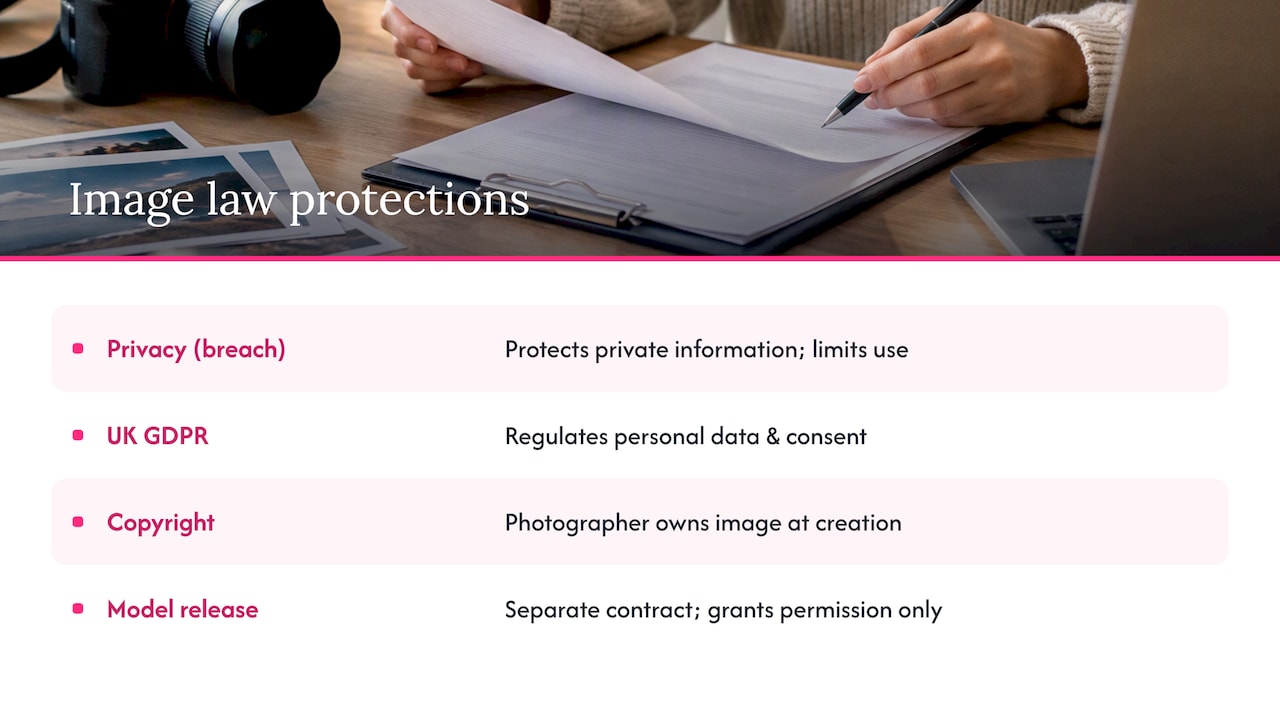
There is no single “model release Act” in the UK, and no standalone legal right to control your own image the way some other countries recognise one. HMRC’s own internal guidance confirms this directly: UK law does not recognise a general “image right”, and protection instead comes from three separate strands working together: privacy law (breach of confidence), data protection (UK GDPR), and copyright.
That matters practically. A release is a contract, built from ordinary contract law, sitting alongside those three protections rather than replacing any of them. Copyright in a photograph belongs to the photographer (or whoever commissioned it under the right terms) from the moment of creation, as GOV.UK’s copyright notice on digital images sets out. A model release is a separate document covering the subject’s permission, and the two need to be read together, not assumed to cover each other.
HMRC’s further notes on image rights repeat the same point: because there’s no formal “personality right” in UK law, commercial exploitation of someone’s likeness is managed entirely through contracts like model releases, not through a statutory image right. That’s precisely why the wording of your release carries so much weight, it’s doing work that no single piece of legislation does for you automatically.
Common disputes and how to resolve them regarding model releases in the UK
Most disputes we hear about fall into a few recurring patterns, and nearly all of them are resolvable without lawyers if you move early.
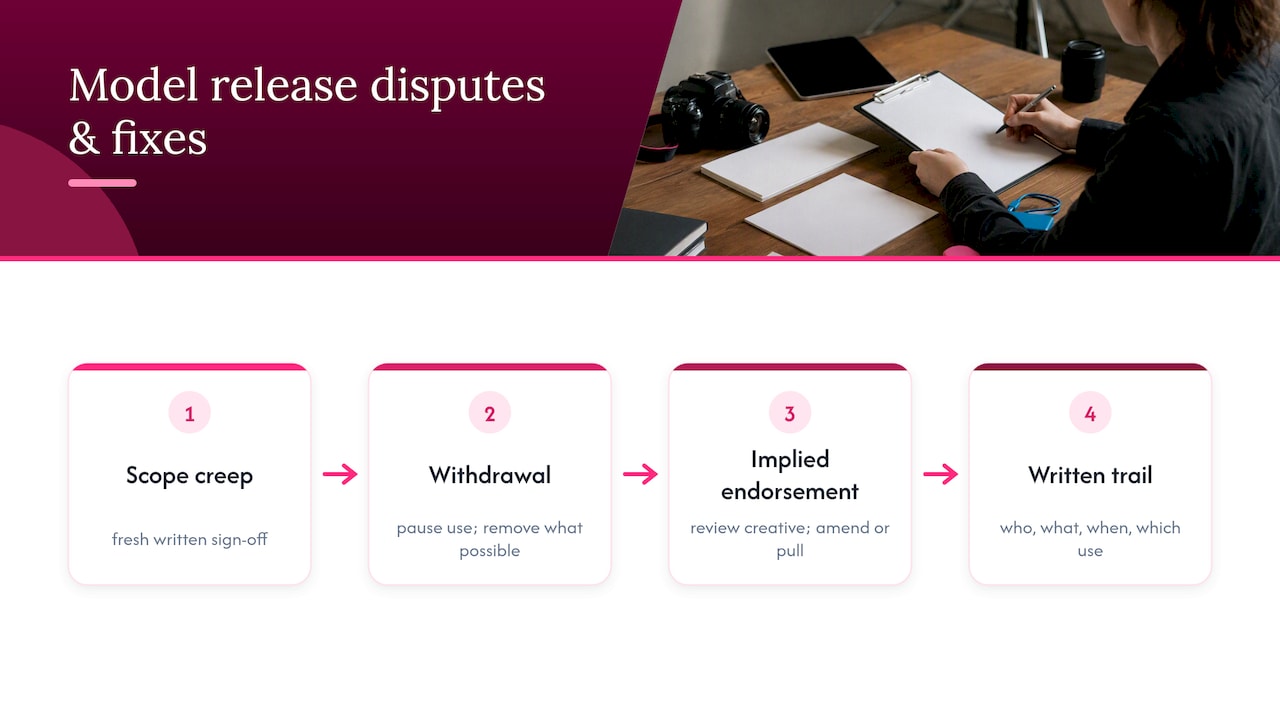
The first is scope creep: an image licensed for one campaign turns up somewhere the subject never agreed to. The fix starts at drafting stage, list actual channels and durations rather than vague catch-all phrases, and when a new use comes up, go back for fresh written sign-off.
The second is withdrawal after the fact. Someone who signed a release six months ago asks for an image to come down. Under the ICO’s consent standard, they’re entitled to withdraw at any time, so the practical response is to acknowledge the request promptly, pause future use immediately and remove what you reasonably can.
The third, and the one with the most reputational risk, is implied endorsement. The ASA’s guidance is clear that a release doesn’t automatically protect against a complaint if the final advert suggests someone personally endorses a product or view they never agreed to be associated with. Resolving this usually means reviewing the final creative against what the release actually permitted, and amending or pulling the piece if the two don’t line up.
Keeping a clear written trail, who signed what, when, and for which use, is what turns most of these situations into a quick correction rather than a prolonged dispute.
How Queer.Photo helps with shoots and permissions
Getting the photography right and getting the paperwork right shouldn’t feel like two separate jobs. We connect clients with photographers quickly and can discuss release requirements for your specific brief before the shoot begins.
- We help brands, publishers and couples work out what kind of release a shoot actually needs, whether that’s a commercial brand shoot or an event with public attendees.
- Image delivery comes with support for collecting and storing releases properly, not an afterthought.
- Our Personal brand package is available, along with other formats including half-day, full-day and video sessions.
If you’re planning a shoot and want releases handled properly from the first conversation, view our pricing or get in touch to brief a photographer.
This article is general information, not a substitute for advice from a qualified lawyer. Consult a qualified legal professional about your own circumstances before acting on anything here.
FAQ
What is a model release in the UK?
A model release is a written agreement where someone gives permission for their image to be used in defined ways, such as advertising, print or online publication. It sets out the permitted channels, duration and territory, but it doesn’t automatically transfer copyright unless the wording says so.
Do I always need a model release for photography in the UK?
You need one whenever a photo will be used commercially, in advertising, or in any context that implies personal endorsement, according to ASA guidance on privacy and permission. Editorial, documentary and purely incidental crowd shots often fall outside that requirement, though reusing them commercially later changes the picture.
How long is a model release valid for?
There’s no fixed statutory expiry date for a UK model release, it runs for whatever duration and uses are written into the document itself. Because consent must remain specific and informed under ICO guidance, it’s good practice to seek fresh permission whenever the intended use changes significantly.
Can someone withdraw a model release after signing it?
Yes. UK GDPR requires that consent be withdrawable at any time, so a subject can ask for further use to stop even after signing. The practical response is to pause new use immediately and remove existing material where reasonably possible.
Does a model release transfer copyright to the client?
No, not automatically. The IPO’s guidance for photographers confirms that copyright stays with the photographer unless the release contains explicit wording assigning it elsewhere.