
Ask Before You Book: UK RAW File Policy, Copyright & GDPR
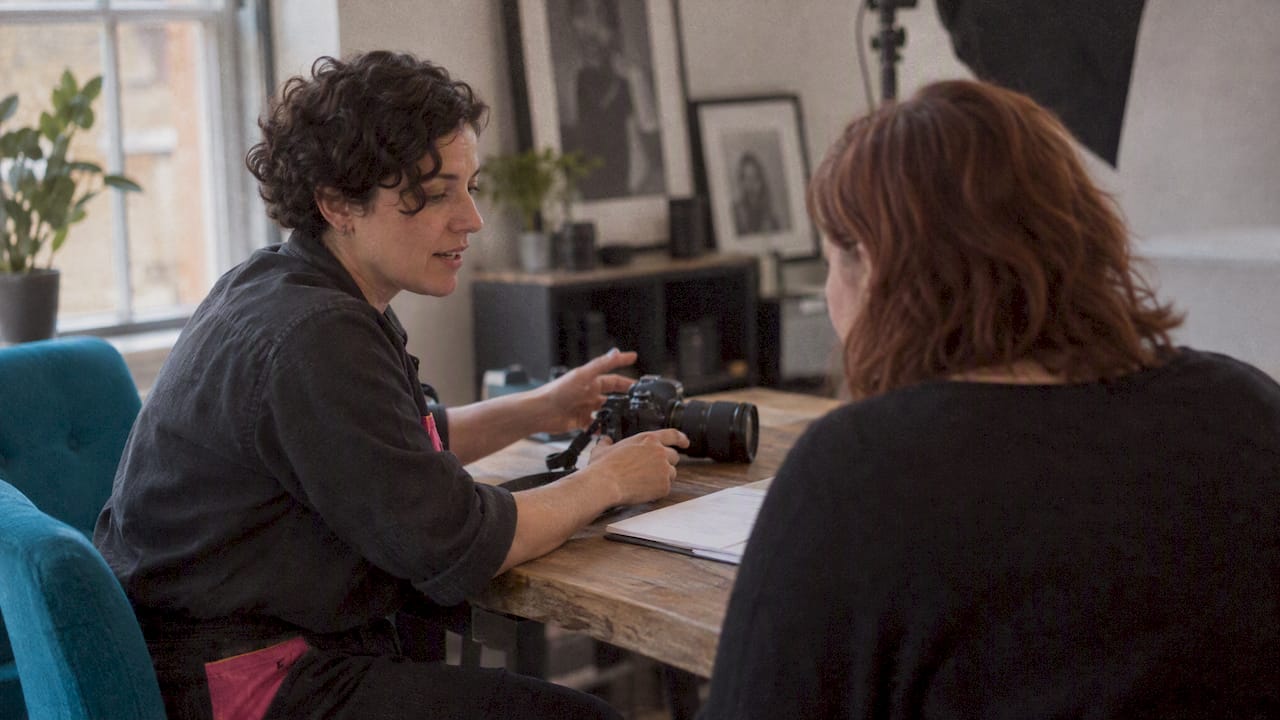
Most photographers do not hand over RAW files as standard, and that is not them being precious. The main reasons are creative and legal: RAW files are unfinished, the photographer usually owns the copyright, and sharing them can create data protection headaches neither of you wants. There are ways round this, but they tend to involve a conversation and sometimes a fee.
TL;DR:
- Under UK law, photographers usually retain copyright after paid shoots; clients receive a usage licence unless a signed written agreement assigns ownership.
- When photos identify people, sharing RAW files can transfer data protection duties to the recipient, including rules for agreed use, retention, and consent withdrawal.
- Ask about RAW access and fees before booking, then put file selection, permitted uses, and any time limits in a signed agreement.
- If you need usable files rather than raw sensor data, request high resolution TIFFs, extra edited frames, or a limited licence for a specific purpose.
- If a photographer agrees, request each RAW file with its matching sidecar; without it, edits may disappear, and compatible software may need updates.
Table of Contents
- What a RAW file actually is and why it differs from your finished photos
- Common reasons photographers withhold RAW files
- UK copyright basics: who owns your photos and what you are actually paying for
- Data protection: what GDPR means for your photos
- How to ask for RAW files and what you can reasonably expect
- Technical realities if you do receive RAW files
- Ethics and industry norms around sharing RAW files
- Legal disputes and what they tend to come down to
- How RAW file policy affects trust between you and your photographer
- What a fair RAW sharing agreement actually looks like
- Book a photographer who tells you upfront what you are getting
- FAQ
- Sources
What a RAW file actually is and why it differs from your finished photos
A RAW file is the raw data straight off the camera’s sensor, before any of the decisions that turn it into a photograph you recognise. No sharpening, no colour grading, no contrast tweaks, none of the small choices that make a photo feel finished. Think of it as the ingredients rather than the meal.
That is why a RAW file opened straight out of the camera often looks flat, grey, or oddly coloured. RAW files require dedicated processing software because the format varies by camera manufacturer and even by model, and the photographer’s edits are what give it the look you were actually promised.
A few practical consequences follow from this:
- RAW files are large, often multiple times the size of a finished JPEG, which makes them slow to send and store.
- They need software such as Lightroom, Capture One or Adobe Camera Raw to open properly, and that software is not free.
- Without the photographer’s camera profile and edits, colours and skin tones can look nothing like what you saw on the day.
- Most phones, printers and photo apps simply cannot read a RAW file at all.
A JPEG or TIFF handed to you after editing is the photograph as intended. A RAW file is the raw material behind it, and on its own it is rarely something you would want to look at, let alone print or post.
Common reasons photographers withhold RAW files
Ask a few photographers why RAW files stay off the delivery list and you will hear some version of the same handful of reasons, repeated with real conviction.
- Creative control. The edit is the craft. A photographer spends hours shaping light, tone and composition, and handing over unedited files undoes that work before anyone sees the result.
- Unfinished product. A RAW file is a draft, not a deliverable, and a client posting an unedited frame can misrepresent what the photographer’s actual work looks like.
- Copyright and licensing. Under UK law, copyright usually sits with the photographer, and giving away RAW files muddies who controls the images and how they can be used later.
- Workflow and time. Culling, editing, exporting and packaging RAW files for a client is extra work on top of the edit itself, and that time has to be paid for somewhere.
- Technical burden. Large file transfers, software compatibility and the need to explain camera profiles to a client all add friction that most studios would rather avoid.
The AOP code of practice puts this plainly: post-production is part of what you are paying a skilled photographer for, which is exactly why RAW files are rarely part of the deal. Buying prints or paying a session fee does not change that.
Pro Tip: If RAW access matters to you, raise it before you book rather than after the shoot. It changes the quote, not just the conversation.
UK copyright basics: who owns your photos and what you are actually paying for
Here is the part that surprises most people. Under UK copyright law, the photographer is the first legal owner of the copyright in any photograph they take, even one they were paid to create, unless a written contract says otherwise. Paying for the shoot, the prints or the digital files does not transfer copyright to you automatically. That has been the legal default since 1 August 1989, though older commissioned work can sit under different rules.
What you are usually buying is a licence: permission to use the finished images for an agreed purpose, such as personal use, a website, or social media. That is different from owning the copyright outright, which would let you edit, resell or license the images to anyone else.
A few things worth checking before you sign anything:
- Whether the agreement describes a licence (permission to use) or an assignment (a transfer of copyright itself).
- What the licence covers: personal use only, commercial use, social media, print, or all of these.
- Whether there is a time limit or geographic restriction on how you can use the images.
- Whether a full copyright assignment is available, and at what cost.
A genuine assignment must be in writing and signed to hold up in the UK, and most photographers who offer one charge for it, since it means giving up rights they would otherwise keep for their own portfolio or future sales.
Data protection: what GDPR means for your photos
If your photos show identifiable people, they count as personal data, and that changes who is responsible for them. Under the UK GDPR and the Data Protection Act 2018, handing over RAW files can shift data-controller responsibilities onto whoever receives them, along with duties around consent, purpose and retention.
In practice, this means:
- Photos can only be used for the purpose people agreed to when they were photographed.
- Files should not be kept indefinitely once that purpose has been served.
- Anyone photographed can withdraw consent, which creates obligations for whoever holds the images.
- A model release or written consent record protects both you and the photographer if questions ever come up later.
This is one reason photographers prefer to control distribution themselves rather than pass along a folder of unedited, unfiltered images that might include shots never meant to see daylight.
How to ask for RAW files and what you can reasonably expect
Getting RAW files, or at least a fair compromise, is mostly a matter of asking the right questions early rather than negotiating after the invoice.
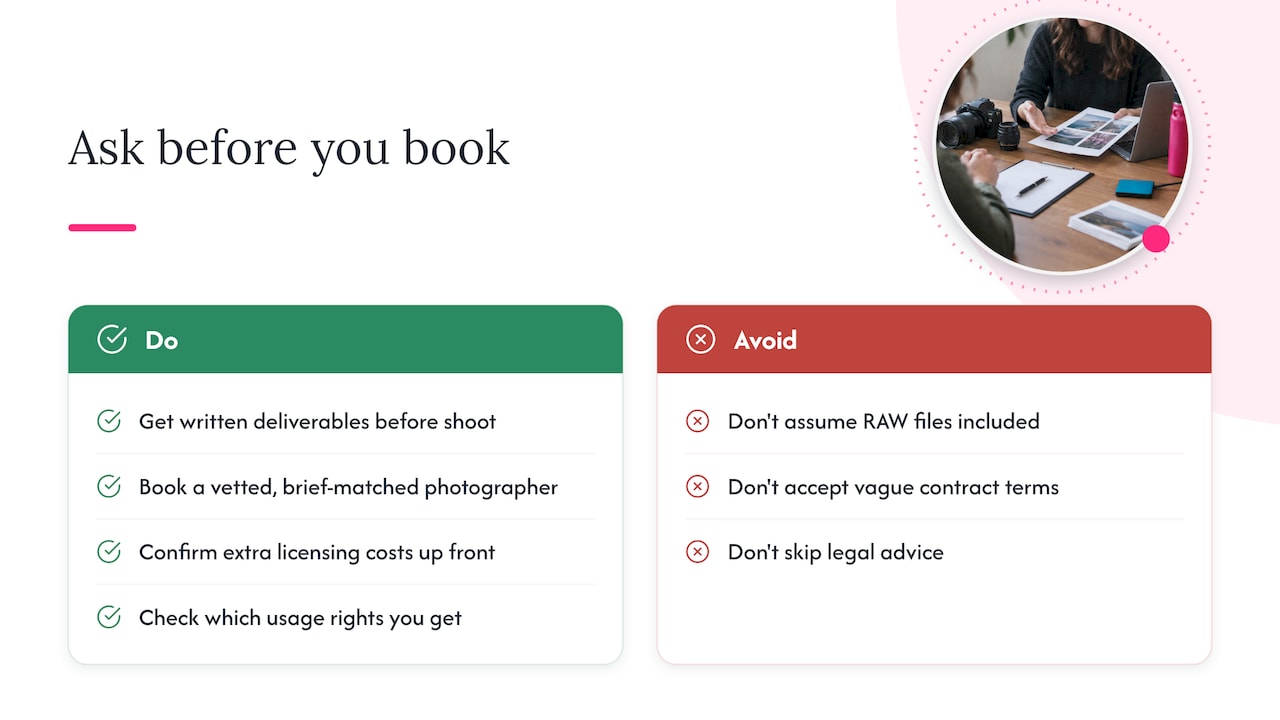
- Ask before booking what the standard delivery includes and whether RAW access is available at all.
- Ask what it would cost to add a limited RAW licence or a full assignment of copyright.
- Propose a middle ground, such as high-resolution TIFFs, a handful of extra edited frames, or a time-limited licence for specific uses.
- Get it in writing, whatever you agree, including exactly which files, what you can do with them, and for how long.
Most studios would rather offer an alternative than hand over raw sensor data. A high-resolution TIFF or JPEG export covers the vast majority of client needs without any of the technical or legal mess, and an extra retouched frame or two often satisfies the request behind the request.
Pro Tip: If you genuinely need RAW for a specific reason, such as a future print campaign, say so specifically. “I might want this for a billboard next year” gets a very different answer than “can I just have everything”.
Technical realities if you do receive RAW files
Even when a photographer agrees to share RAW files, you are taking on a few technical headaches they would otherwise have handled for you.
- You will need software that can read the specific format, and camera manufacturers update RAW support regularly, so a newer camera model may need a software patch before it opens properly in Lightroom, Photoshop or Capture One.
- Edits are often stored in a separate sidecar file (XMP), not inside the RAW itself, so opening the RAW without its matching sidecar means you see none of the photographer’s work, just the flat original.
- Mismatched timestamps or missing sidecars can cause edits to be ignored entirely, leaving you with something that looks nothing like what was agreed.
If you do end up with RAW files, convert them to DNG for long-term storage, keep a backup separate from your working copy, and ask the photographer to package the RAW alongside its sidecar file so none of the intended look gets lost along the way.
Ethics and industry norms around sharing RAW files
Industry guidance treats RAW files as part of the photographer’s working process rather than a client deliverable, and that norm exists for a reason beyond simple caution. A photographer’s reputation rests on consistent, finished work, and unedited frames circulating under their name can misrepresent the quality they actually deliver.
There is also a fairness angle. Editing is a skill built over years, and treating RAW files as something owed alongside the shoot fee undervalues that work in the same way expecting a chef to hand over their recipe book might. Most professional codes, including the AOP’s own guidance, frame finished images, not raw sensor data, as the actual product being sold.
That said, ethical practice cuts both ways. A photographer who refuses every request for flexibility, or who is vague about what a client is actually licensed to do with their images, is not meeting their end of the bargain either. The healthiest norm sits in the middle: clear communication about what is included, what costs extra, and why RAW specifically is being kept off the table.
Legal disputes and what they tend to come down to
Most disputes over RAW files are not really about the files themselves, but about mismatched expectations that were never written down. A client assumes payment for a shoot includes everything generated during it, while the photographer assumes the fee covers a finished set of edited images and nothing more.
Where these disagreements escalate, they tend to hinge on exactly the point covered above: whether copyright was ever assigned in writing, and whether the usage licence was clearly scoped. Because UK law defaults to photographer ownership unless a signed agreement says otherwise, clients who assumed broader rights than they were granted are usually the ones left disappointed. The lesson is consistent across most trade guidance: a contract that specifies deliverables, usage rights and any RAW access in plain terms avoids the argument before it starts.
How RAW file policy affects trust between you and your photographer
A clear RAW policy, stated upfront, tends to build trust rather than erode it. Clients who understand why they are getting edited images rather than a dump of raw files generally feel better looked after, not shortchanged, because the explanation makes sense once it is actually given.
The relationship tends to sour when the policy is unclear or only mentioned after a client asks. Silence on the subject reads as evasiveness even when the photographer has entirely reasonable reasons, and that is avoidable with one paragraph in the booking information. On a boudoir shoot or a personal portrait session where the images are sensitive, this matters even more: being told upfront what happens to every frame, edited or not, is part of feeling genuinely safe during a shoot, not just satisfied with the result afterwards.
Trust also flows the other way. A photographer who is flexible about reasonable requests, rather than treating every question as an attack on their process, tends to keep clients coming back and recommending them to others.
What a fair RAW sharing agreement actually looks like
There is no single industry-standard RAW sharing contract, but the better agreements tend to cover the same handful of points regardless of who drafted them.
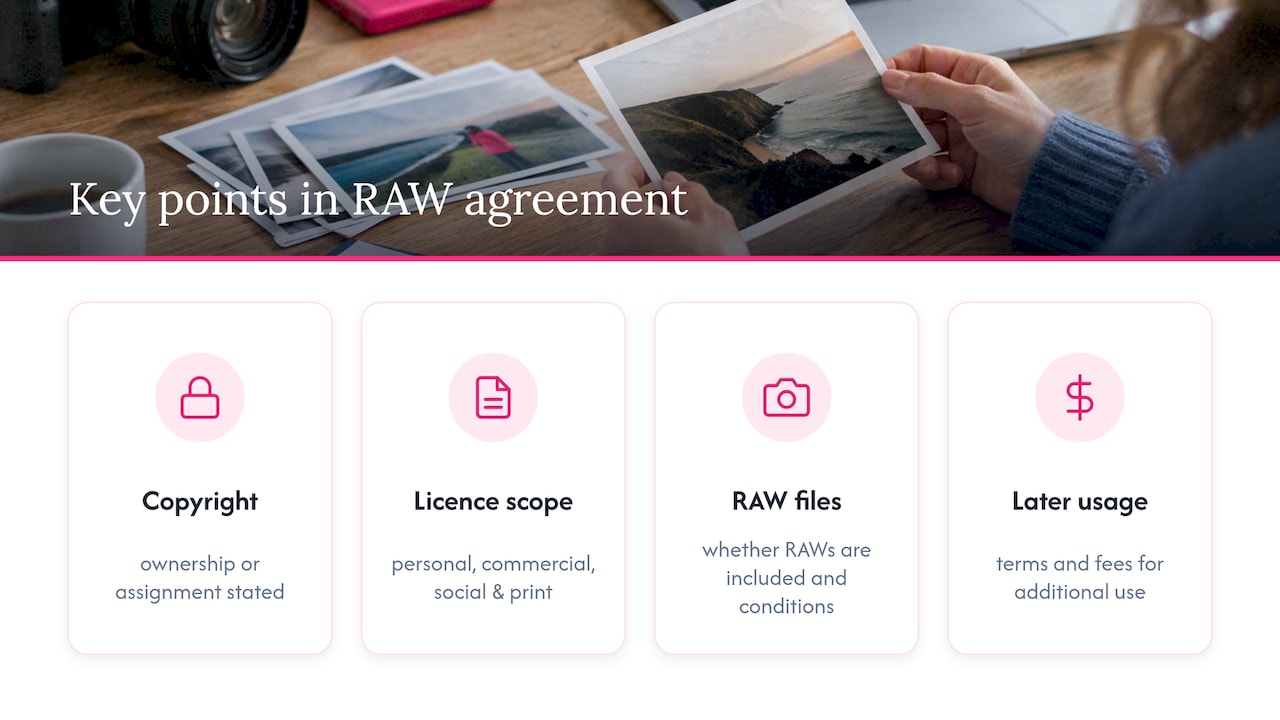
A workable agreement usually states plainly whether copyright stays with the photographer or is being assigned, what the client’s licence actually covers (personal use, commercial use, social media, print), whether RAW files are included at all and under what conditions, and what happens if the client wants additional usage later. For commercial work, such as a branded shoot or conference photography, this detail matters more, since the business uses tend to be broader and the stakes of ambiguity higher.
If you are commissioning anything with a more sensitive subject, such as trans portrait work, it is worth asking that consent and image rights be addressed explicitly in writing, not left to a verbal understanding on the day. A short written note confirming what was agreed protects everyone involved, and it does not need to be a lengthy legal document to do its job properly. If you want a template to start from, our partner resource on image rights and model consent covers the practicalities in more depth.
Book a photographer who tells you upfront what you are getting
We think the RAW files question should never be a surprise, which is why every shoot we arrange comes with clear terms about deliverables and usage before a camera is ever picked up. Photographers are vetted and personally matched to your brief, ensuring a personal touch extends to the paperwork as much as the photography itself.
Whether you are booking a personal brand session from £200, a wedding, or an editorial shoot, we make sure you know exactly what is included in your package and what any additional licensing or assignment would cost, so there are no unpleasant conversations after the invoice. Our photographers keep copyright as standard practice, in line with UK law, but we are always upfront about what usage rights come with your package and what it would take to extend them.
If you are ready to book with someone who treats this conversation as part of the service rather than an afterthought, find a queer photographer in London and get matched with a specialist who fits your project.
This article is general information, not a substitute for advice from a qualified lawyer. Consult a qualified legal professional about your own circumstances before acting on anything here.
FAQ
How do I open a .RAW file?
You need dedicated software such as Adobe Camera Raw, Lightroom or Capture One, since RAW files require specific processing tools to convert sensor data into a viewable image. Standard photo viewers and most phones cannot open RAW files without an update or a converter app.
What is the 20 60 20 rule in photography?
This is a compositional guideline some photographers use for structuring a shot, though definitions vary depending on who is teaching it. It is not an official industry standard, and no authoritative source ties it to a fixed rule, so treat any specific version you encounter as one photographer’s personal approach rather than a settled convention.
Should I shoot iPhone photos in RAW?
RAW on an iPhone gives you more editing flexibility and detail, but the files are larger and need processing software to use properly, much like RAW from a professional camera. For everyday photos, the phone’s standard processed format is usually easier to use straight away.
Do photographers usually give clients copyright along with the images?
No. Under UK law, the photographer is the first owner of copyright by default, and paying for a shoot typically grants you a usage licence rather than ownership of the copyright itself. A full transfer of copyright is a separate, usually paid, arrangement that must be agreed in writing.
Sources
These are the sources behind the legal and technical points above, worth a look before you discuss usage rights or RAW access with a photographer.
- Gov
- Photography guidance and data protection (University of Edinburgh / data-protection guidance)
- What is a RAW file and how do you open it? (Adobe)
- AOP code of practice (Association of Photographers)