Pride in London Photography Guide: Where, When and How
Pride in London is the biggest day in the capital’s LGBTQ+ calendar, and one of the hardest to photograph well. The parade is long, the crowds are dense, and the best pictures are often not of the floats. This guide covers the route, the rules for working professionally, how to ask for consent, where to find the quieter moments, and when it makes sense to hand the job to someone who is part of the community.
We are a London agency that matches people and organisations with queer photographers, so we write this from the side of the lens. Some of it is for people shooting on their own. Some is for brands and organisers deciding how to cover Pride properly.
TL;DR
- The 2026 parade ran on Saturday 4 July, from 12:00pm to 6:00pm, from Hyde Park Corner to Whitehall via Piccadilly. Check the Pride in London site for next year’s date.
- You don’t need a permit to photograph in public, but working commercially on the route, at stages or in media areas needs official media accreditation, applied for well ahead.
- Ask before you photograph a person as the focal point, and get written consent before any image goes into marketing.
- Some of the strongest images come from the edges: the family area, the quiet spaces, the build-up and the walk home.
- For brand, campaign or workplace coverage, commissioning a vetted queer photographer is safer and gives you better pictures than collecting shots on the day.
Table of Contents
- The day, the route and the timings
- Do you need a permit or accreditation?
- Photographing people with respect
- Beyond the parade: where the honest pictures are
- Practical tips for shooting a crowd
- Press photography and community-led photography
- If you are a brand or organiser
- Working with us on Pride coverage
- A simple plan for Pride day
- FAQ
- Sources
The day, the route and the timings
The Greater London Authority’s listing for the 2026 parade gives Saturday 4 July 2026, 12:00pm to 6:00pm. It describes a route that starts at Hyde Park Corner, runs along Piccadilly to Piccadilly Circus, heads down Haymarket past Trafalgar Square and finishes on Whitehall. The Metropolitan Police confirmed the same route when it announced officers deployed across central London that weekend.
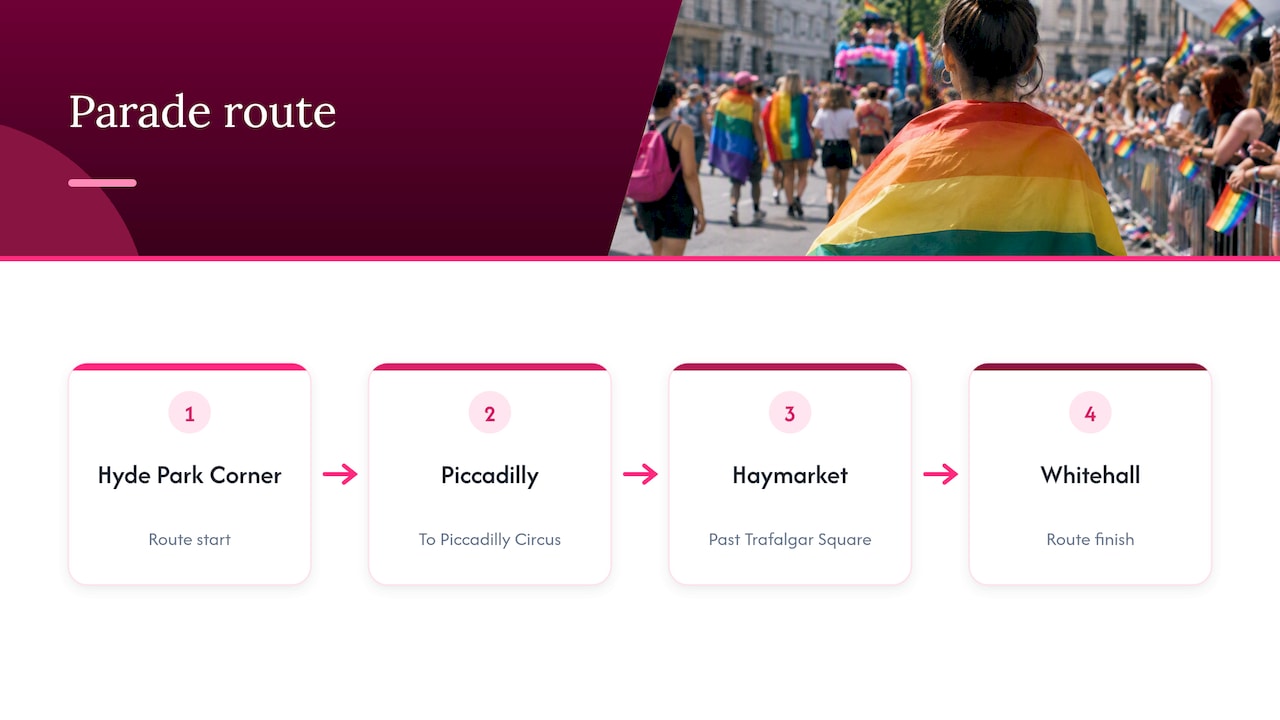
The scale matters for photographers. BBC reporting puts attendance at over a million people, and a full procession can take four to five hours to pass a single point. Expect station closures and crowding around Oxford Circus and Piccadilly Circus.
A useful rule of thumb: you will not see all of it, so decide what you are there for before you leave home.
Choosing your spot
The route has very different characters along its length:
- Piccadilly: wide, long sightlines, good for groups walking towards you with the buildings behind them.
- Piccadilly Circus and Haymarket: busy and bright, with bigger crowds and more chaos. Good for energy, harder for clean frames.
- Trafalgar Square and Whitehall: the finish, with the denser crowds and the stages. The light is lower in the late afternoon, which can flatter faces.
The official planning page lists the best places to watch, welfare areas and other practical details, so read it before you pick a spot.
Do you need a permit or accreditation?
Short answer: it depends on whether you are working.
The Metropolitan Police’s photography advice says it wants to protect the public from terrorism while respecting the freedom of the public and the media to take and publish photographs. In practice, a visitor with a camera in a public street is fine.
Professional work is different. Pride in London states that media accreditation is required for journalists, photographers and videographers who need access to the parade route and stage areas. Apply early, and carry your confirmation, printed or on your phone. Stewards are there to keep pedestrian flow and safety corridors clear, and they will stop setups that block them.
Two further points for commercial crews:
- Roads: if you plan to film or photograph on a Transport for London red route, you need permission first. TfL’s filming and photography page sets out the application and fees, which start at £112.50 for a small crew of up to five people.
- Pride’s own images: Pride in London says its own photographs are reserved for sponsors and media partners, so ask permission and credit the photographer if you want to use them.
One small thing that shows you have done your homework: the organisers ask people to use the name Pride in London rather than “London Pride” or “gay pride”, as they explain on their media centre page. We follow that here.
Photographing people with respect
Pride is public, but that does not make everyone in it a model. For many people, being visibly queer at Pride is a choice they have made for one day. A photograph that travels further than they expected can be a real problem for them, at work or at home.
Ask first, especially for close shots
If someone is the focus of your frame, ask. It takes five seconds, and it usually improves the picture because the person looks at you rather than past you. A smile, a raised camera and a “can I?” is all you need. If the answer is no, say thanks and move on.
Be extra careful with anyone who looks tired, overwhelmed or emotional, with young people, and with anyone near a welfare area.
Commercial use needs consent in writing
The ICO’s advice on taking photographs is aimed at schools, but the principle carries over: data protection law does not stop you taking photos in a public place, yet using identifiable images for marketing needs a clear lawful basis. For brand campaigns, social ads and anything else that sells something, written consent from each identifiable person is the safest route and protects you if someone later changes their mind.
Pride in London’s Code of Conduct also applies to everyone taking part, including how people behave around others. Read it if you are shooting for an organisation.
If you want a checklist of what a UK shoot should cover, our event photography shot list includes UK consent prompts.
Who owns the pictures?
Under the Copyright, Designs and Patents Act 1988, the photographer is normally the first owner of copyright. GOV.UK’s guidance on ownership of copyright explains that this holds unless a written agreement says otherwise. If you commission photographs, get the ownership and licence terms in writing before the shoot, covering where and for how long you can use the images.
Beyond the parade: where the honest pictures are
The march is loud and colourful, and everyone photographs it. The pictures people remember tend to come from somewhere slower.
- The build-up. Groups gathering, last-minute glitter, someone’s friend fixing a collar. Nobody is performing yet.
- The family area. Pride in London’s planning page points to spaces such as the Family Area at Victoria Embankment Gardens and the Quiet Pride zone, where people recharge.
- The walk home. Tired feet, flags over shoulders, strangers sharing a train carriage.
- Details. Hand-painted signs, badges, jackets with decades of pins.
Treat the quiet spaces as exactly that. They are there so people can step away from the noise, and a camera pointed at someone resting can undo the trust that makes them feel safe. Ask the organisers or stewards what is appropriate before you raise a camera there.
Practical tips for shooting a crowd
If you are shooting for yourself, a few habits help more than any piece of kit.
- Travel light. A single zoom, such as a 24-70mm equivalent, covers most of the day. You will be on your feet for hours.
- Go for the middle distance. Waist-up portraits and small groups tell more than wide shots of a sea of heads.
- Watch the light. Midday sun on Piccadilly is hard. Step into shade for portraits and use the sun as a back light when you can.
- Shoot from the edges of the crowd, not the middle, so you are not blocking the route or the pavement.
- Charge everything and bring a power bank. Phone signal in dense crowds can be poor, so download maps in advance.
- Keep the stewards on side. Follow instructions quickly and without argument.
If your camera is your phone, these phone photography basics apply to Pride as much as anywhere else: clean the lens, tap to set focus and exposure on your subject, and take several frames of every moment.
When you post, caption with care. Tag people only if they have told you they are happy to be tagged, and if you want to add some colour to a caption, a list of Pride emojis and their meanings can help you pick the right flags.
Press photography and community-led photography
There is a difference between pictures of a community and pictures made within it. Speaking to the BBC, Stef Dickers of the Bishopsgate Institute described how photo agencies hold press images of Pride, and why archives made by LGBTQ+ photographers photographing their own community have a particular power.
We see this in our work. A photographer who has marched, volunteered or danced at Pride knows when to hold back, which moments are theirs to take and which are not. That shows in the frames: people look relaxed rather than watched.
If you are a brand or organiser
Pride is a day when many companies want to be seen. The question is how to document your involvement without simply borrowing the aesthetic.
Pride in London’s director, speaking to the BBC, said the event cost £1.7m in 2024, much of it going on keeping people physically safe through security, barriers and road closures. That is a useful reminder that taking part comes with responsibilities, and that your photography should reflect real collaboration with the community.
Some principles for brand coverage:
- Plan the shoot, don’t harvest it. Agree a brief, consent routes and credits in advance.
- Show the people actually involved. Your own staff, partners and community groups, with their agreement, not anonymous faces from the crowd.
- Avoid token shots. Our guide to corporate LGBTQ+ event photography explains how planners can avoid them.
- Think beyond one day. Pride month content, workplace events and a year-round story all need images. Our creative campaign photography ideas are a starting point.
- Choose original imagery. Stock libraries hold thousands of Pride images, but they are not your people, your march or your story.
Pride in London also publishes guidance for parade groups walking without floats, written with the Greater London Authority and other agencies. If your organisation is marching, share it with whoever is photographing you so everyone knows the rules on the day.
Working with us on Pride coverage
Queer.Photo is a London agency that represents a select roster of queer photographers. Every photographer is vetted and personally represented, and a real person, not an algorithm, matches you to the right one, often within 24 hours. All imagery is original, never stock or AI generated. Shoots respect pronouns and personal boundaries, and photographers are properly credited.
Depending on what you need, these pages are the best place to start:
- Pride event photographer in London for parade-day and Pride events.
- Pride campaign photography for brands planning Pride month content.
- Workplace Pride events for internal celebrations and staff networks.
- Queer Pride portrait sessions if you would like portraits made for yourself.
- Documentary photography for longer stories about a community or organisation.
Our prices page lists the packages, including Personal brand from £200 one-off. Other packages, such as Half day, Full event and Day rate, are described there too, and you can book and pay securely online. You can also browse our roster of queer photographers before you decide.
A simple plan for Pride day
Whether you are shooting for yourself or briefing someone else, work backwards from the day.
- Weeks before: apply for media accreditation if you are working commercially, and confirm any TfL permission if you plan to use a red route.
- A week before: agree the brief, the shot list, the consent process and who owns and can use the images.
- The day before: check the route, closures and your spot. Charge batteries, clear memory cards.
- On the day: arrive early, keep your accreditation to hand, and take a break away from the crowd.
- Afterwards: back up the images the same night, choose a small set, and send people the pictures you took of them if you promised to.
FAQ
Do I need permission to take photos at Pride in London?
Not to photograph in public as a visitor. If you are working as a journalist, photographer or videographer and need the parade route or stage areas, Pride in London requires media accreditation. It is polite, and often wise, to ask anyone you photograph closely.
Can I use Pride photos in my company’s marketing?
Only with care. Identifiable people should give written consent before their image is used in marketing, and you should have a clear agreement about copyright with your photographer. Using photos of strangers from the crowd in a campaign is ethically and legally risky.
Where is the best place to photograph the Pride in London parade?
The route runs from Hyde Park Corner along Piccadilly, down Haymarket past Trafalgar Square to Whitehall. Piccadilly offers wider sightlines, while the finish is busier. The family area and quiet spaces offer a different, more intimate kind of picture, but be respectful there.
Is it better to hire a queer photographer for Pride coverage?
For brand and event work, we think so. A photographer from the community understands the moments to capture and the ones to leave, and people tend to relax around them. We match you with one personally, often within 24 hours.
Sources
- Pride Parade 2026, Greater London Authority
- BBC News: Pride in London costs and scale
- Planning your visit, Pride in London
- Photography advice, Metropolitan Police
- Media Centre, Pride in London
- Filming and photography on the roads, Transport for London
- Code of Conduct, Pride in London
- Taking photographs: data protection advice, ICO
- Ownership of copyright works, GOV.UK
- BBC News in pictures: Pride archives