
Printable Wedding Shot List That Saves Time and Honors Queer Families
A wedding shot list is simply a written plan of the images you most want your photographer to capture, organised so nothing important gets missed in the rush of the day. The essentials fall into six groups: ceremony key moments, couple portraits, family and group formals, detail shots, reception highlights, and candid reactions. Mark your absolute must-haves clearly, then share the list with your photographer well before the day itself.
TL;DR:
- Prioritize including full family group shots, starting with the couple and parents, then moving to extended family and close friends, allotting five to eight minutes per group.
- Schedule around sunset for golden hour portraits, allowing 10 to 20 minutes near the ceremony site and up to 60 minutes for creative shoots at different locations.
- Coordinate with both photographer and videographer on camera positions and shared shot lists to prevent overlapping shots and ensure smooth, unobtrusive coverage.
- Share a marked-up shot list with priorities at least two weeks before the wedding, and clarify licensing and rights to avoid misunderstandings afterward.
- Adapt formal groupings and posing to include queer, same-sex, and blended families by listing guests with correct names and pronouns and avoiding gendered poses.
Table of Contents
- Phase-by-phase shot list: getting ready, ceremony, portraits, reception
- Formal family and group shots: an ordered checklist to save time
- Couple portraits and timing: styles, golden hour and how long to allow
- Wedding video shot list basics and coordinating with your photographer
- How to customise and share your shot list before the big day
- Inclusive adaptations for queer, same-sex and blended-family weddings
- How Queer.Photo helps you turn this list into your actual wedding photos
- Sources
- FAQ
Phase-by-phase shot list: getting ready, ceremony, portraits, reception
Breaking your list into phases keeps everyone calm and on schedule, and it means your photographer knows exactly where to be and when. Print it, put it in the couple’s folder, and hand a copy to whoever is coordinating the day.
Getting ready:
- Rings, invitation suite, shoes and any heirloom jewellery laid out together
- Dress or suit on a hanger, plus close-ups of buttons, lace or tailoring details
- Candid moments with parents or the wedding party helping with final touches
- A first look, if you have planned one, capturing genuine reactions rather than a pose
Ceremony:
- Venue establishing shot before guests arrive
- Processional, including the entrance of the wedding party
- Exchange of vows and rings
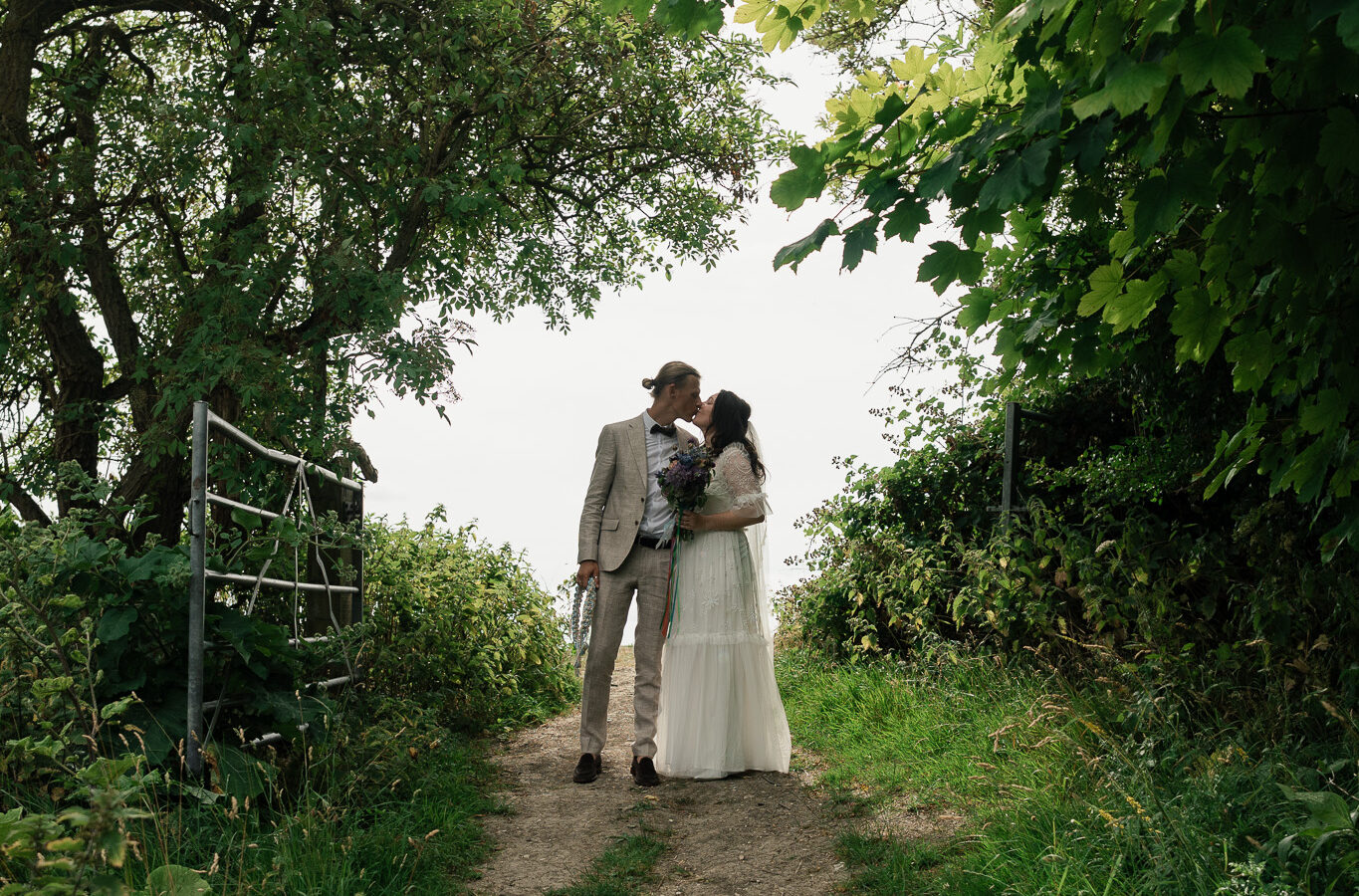
- The first kiss
- Signing of the register or legal paperwork
- Recessional as the couple leaves
- Candid reactions from guests, especially parents
If your ceremony is happening outdoors at an approved venue, build in a few extra minutes: the guidance for outdoor civil ceremonies confirms that the superintendent registrar must approve the specific outdoor spot in advance, so your photographer’s shot of the “outdoor setting” needs to match what was actually signed off.
Portraits and bridal party: a handful of quick, flattering shots near the ceremony space, then a slightly longer set with the full wedding party if time allows. Simple prompts like walking hand in hand or a shared laugh tend to look more natural than a stiff line-up.
Reception: entrance of the couple, speeches, first dance, cake cutting, dancefloor energy, and the send-off. These are the shots that carry the atmosphere of the evening, so leave enough breathing room in the schedule for your photographer to actually catch them rather than chase them.
Formal family and group shots: an ordered checklist to save time
Family formals eat more time than any other part of the day if they are not planned. Work through the biggest groups first, then peel off into smaller combinations so nobody stands around waiting.
- Couple with both sets of parents
- Couple with immediate family only (siblings, parents)
- Couple with extended family (grandparents, aunts, uncles)
- Couple with the full wedding party
- Smaller combinations: couple with each parent individually, siblings only, godparents, close friends
Write out a named list in advance and nominate one person, ideally someone who knows every face in the crowd, to physically gather each group as it is called. Give your photographer roughly five to eight minutes per group, and avoid repeating a combination you have already shot in a different order.
Pro Tip: Hand your family organiser a printed copy of the group list, not just a verbal briefing. They will thank you when great-aunt Josephine wanders off mid-photo.
Couple portraits and timing: styles, golden hour and how long to allow
Some couples want posed, deliberate portraits; others prefer a documentary approach where the photographer follows rather than directs. Most weddings benefit from a mix: a few classic poses for the family album, then some unscripted walking-and-talking shots for everything else.
Golden hour, the soft light in the hour before sunset, is worth protecting in your timeline, even if it means slipping away from the reception for fifteen minutes. Tell your photographer your ceremony time and venue early so they can calculate when that light will fall on your specific date.
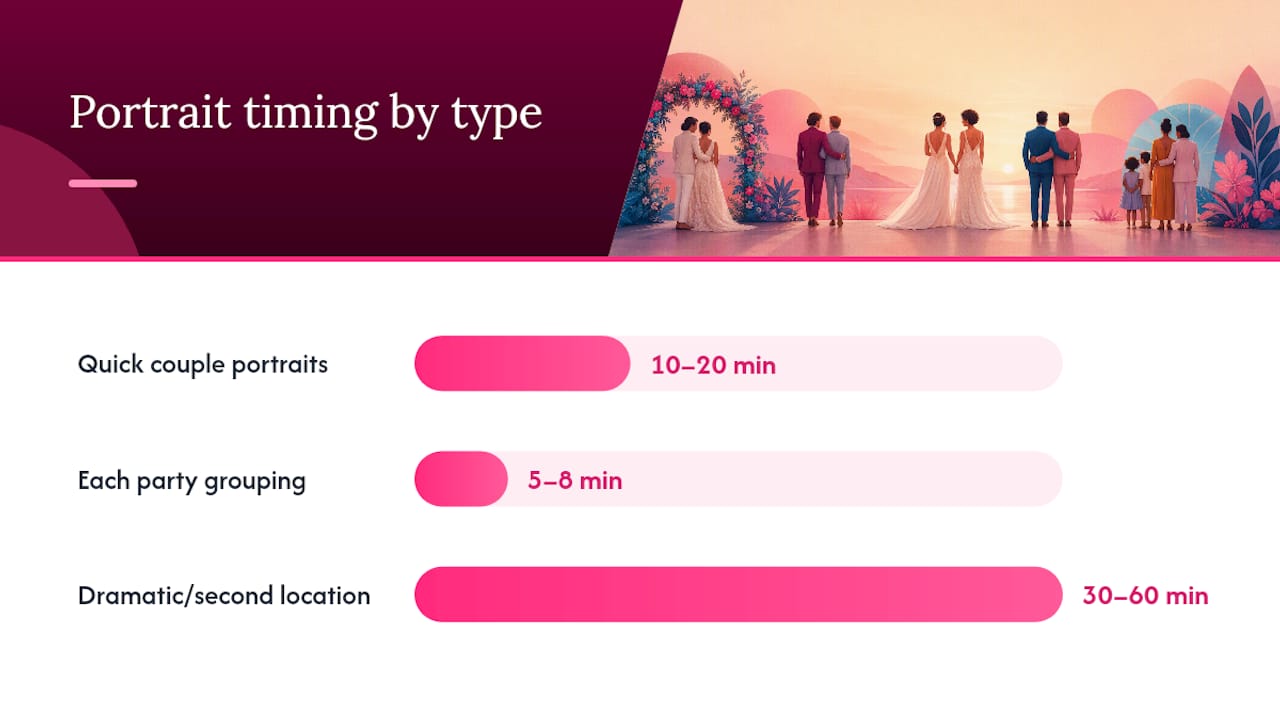
- Quick couple portraits near the ceremony venue: allow a short window, often around 10 to 20 minutes
- A fuller set with the wedding party: build in a bit more time, generally 5 to 8 minutes per grouping once you total up several combinations
- A dramatic second location or creative session: set aside 30 to 60 minutes if travel and light allow
A comprehensive video and photo template breaking shots down by phase shows how much planning goes into portrait timing across a full day. A wedding video shot list built around 100 or more essential shots demonstrates just how many moments a well-organised couple can capture without anyone feeling rushed.
Wedding video shot list basics and coordinating with your photographer
If you have booked both a photographer and a videographer, a shared shot list stops them from standing in each other’s frame. The core video shots mirror the photo list: an establishing shot of the venue, close-ups of guest reactions during vows, a slow pull across the room during speeches, and movement shots of the couple walking or dancing.
- Agree camera positions in advance so the videographer isn’t crossing the photographer’s sightline during the vows
- During quiet moments like the signing, both teams should move slowly and stay low profile
- Flag any low-light spaces early. Video often needs more light than stills, so a photographer working with flash and a videographer relying on ambient light may need different positions for the same moment
A quick five-minute call between both vendors before the day resolves most of this without anyone needing to improvise on the spot.
How to customise and share your shot list before the big day
A template only works once it reflects your actual wedding. Here’s how to turn a generic list into your day-of brief.
- Go through every shot and mark it A (must have), B (would love), or C (nice if time allows)
- Send the marked-up list to your photographer at least two to three weeks before the day
- Ask your lead photographer directly about coverage windows, whether a second shooter is included, typical editing turnaround, and what licence you will have to use the images afterwards
- Decide who holds the physical or digital copy on the day, usually the couple’s planner or a trusted friend
- Build in a short buffer for substitutions. Weather, timing slips and last-minute guests all mean something on the list may need to change
Pro Tip: Ask your photographer how they usually handle the copyright side of things. Under GOV.UK copyright guidance, the photographer normally owns copyright in commissioned images by default, so agree a usage licence in writing if you want to print, post or share freely.
Inclusive adaptations for queer, same-sex and blended-family weddings
A shot list built for a traditional nuclear family often misses the mark for blended families, chosen family, or same-sex couples with two mothers or two fathers rather than a bride and groom pairing. A few small changes make a real difference.
- List every guest’s correct name, pronouns and relationship label on the group sheet, not just “mother of the bride” style shorthand
- Reorder formal groupings so step-parents, chosen family and close friends are given the same weight as biological relatives
- Give your photographer plain examples of what matters: “capture both mums walking her down” or “no gendered poses, just us as we are”
Queer.Photo’s own work with LGBTQ wedding photography in London reflects exactly this approach: the shot list serves the family in front of the camera, not the other way round.
How Queer.Photo helps you turn this list into your actual wedding photos
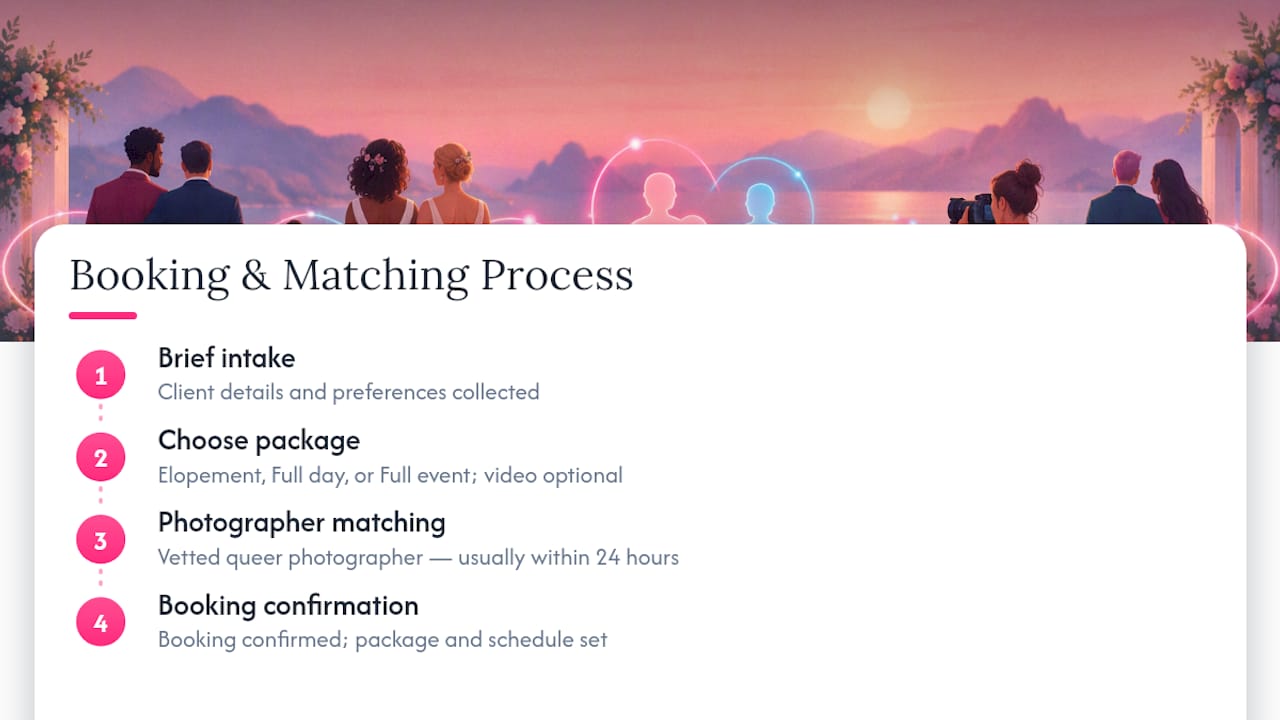
Once your list is written, the next step is finding someone who will read it properly. Queer.Photo matches you with a vetted queer photographer, personally, usually within 24 hours, so your shot list lands with someone who already understands the people and relationships on it. Wedding coverage is available as Elopement, Full day or Full event packages, with video coverage listed among the photography and video services on offer. Booking typically begins with a brief intake, followed by photographer matching and confirmation. Find your photographer at Queer.
Sources
- Guidance for venues: outdoor civil marriage and civil partnership ceremonies
- Wedding Video Shot List — 100+ essential shots
FAQ
What to include in a wedding shot list?
A usable list covers ceremony key moments, couple portraits, family formals, detail shots of rings and dress, reception highlights, and candid guest reactions. Mark each item by priority and share it with your photographer ahead of the day so nothing gets missed.
What shots are essential for a wedding?
The non-negotiables are the processional, vows, ring exchange, first kiss, signing of the register, and recessional, alongside a handful of family formals and couple portraits. Beyond those, detail shots and candid reception moments round out a complete album.
What is the 20 60 20 rule in photography?
This isn’t a formally documented photography standard, and definitions vary depending on who you ask. Some photographers use it loosely to describe splitting a wedding day into preparation, ceremony and reception in roughly those proportions, but there’s no single agreed rule behind it.
What’s a good wedding shot?
A good wedding shot captures a genuine moment rather than a forced pose, whether that’s a candid laugh during speeches or an unguarded glance during vows. The strongest images usually come from photographers who know the couple’s actual relationships and family structure, not just a generic checklist.
Do I own the copyright to my wedding photos?
Not automatically. Under GOV.UK copyright guidance, a commissioned photographer usually retains copyright by default, so agree a usage licence or written assignment with them if you want broader rights to print or share your images.